
Process R&D
Turning a route that works once into a route that works every time.
A discovery route is written to get a compound made. A process route is written to get it made again — at a larger scale, by a different chemist, with a predictable outcome. Process R&D at WesynTech is the work of moving from the first to the second.
Where this fits
Process development sits between custom synthesis and production. It is the stage where a route that produced the first grams is re-examined before it is asked to produce the first kilograms — and where the cost and the failure modes of a programme are usually decided.
What the pilot plant allows
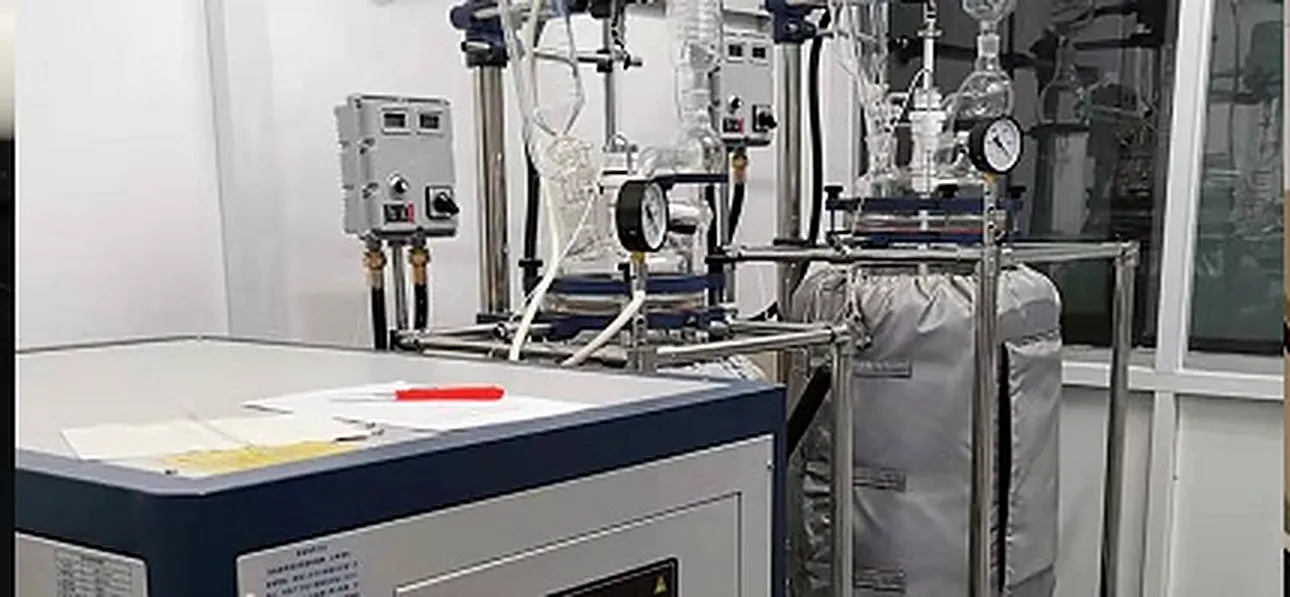
The standard pilot plant holds two 20 L single-layer reactors, six 50 L double-layer reactors supporting routine reactions from −70 °C to 200 °C, and four 50 L rotary evaporators. That temperature window matters: cryogenic lithiations and high-temperature cyclisations can both be run without leaving the building.
What gets looked at
Impurity formation and where it enters; the steps that will not tolerate a longer hold time at scale; solvent volumes; work-up and isolation; and metal residues from organometallic reagents and homogeneous catalysts — a problem WesynTech has written about publicly in its technical notes.
How it runs
Four steps, no hand-offs
The same people stay on the project from the first assessment to the last delivery. That is the whole reason the sequence is this short.
- Route reviewThe existing route is mapped step by step, with the risky operations identified before anything is run.
- Laboratory optimisationConditions, stoichiometry, solvent and work-up are revised against the constraints of larger equipment.
- Pilot-scale confirmationThe revised route is run in the 20 L and 50 L reactors to confirm it behaves as predicted outside a round-bottom flask.
- Transfer packageThe route, the controls and the analytical picture go forward together, whether production stays in-house or moves to a partner plant.
Questions about Process R&D
What reaction temperatures can you run at pilot scale?
The six 50 L double-layer reactors support routine reactions from −70 °C to 200 °C.
Do you work on routes developed elsewhere?
Yes. Process R&D is offered on routes that came from the customer or from a third party, not only on routes WesynTech wrote.
How do you handle metal residues from catalytic steps?
It is treated as a process question rather than a purification afterthought. WesynTech's published technical note on dithiocarbamate scavengers describes the approach in detail.
The other two services
Early-stage R&D
Custom Synthesis
Gram-to-kilogram synthesis of compounds that are not on anyone's catalogue.
Scale-up supply
API & Intermediate Production
Repeat supply of starting materials and key intermediates for scale-up programmes.
Looking for a specific compound instead? Search the 672-compound catalogue.
Start with the structure
Send what you need made, how much of it and by when. You will get a route assessment back, not a brochure.