


The Aluminum Foil Supply Chain Explained: From Bauxite Mining to Jumbo Roll Production
Learn how aluminum foil is made from bauxite mining to jumbo roll production. Explore the complete aluminum foil supply chain, common alloys, manufacturing processes, and sourcing tips for buyers.
Product quality does not start when a master coil is loaded onto a slitting machine. It begins deep in the earth and is refined through highly technical metallurgical processes.
By understanding the journey from bauxite to aluminum, you can make smarter purchasing decisions. You will know exactly what questions to ask your aluminum foil supplier, how to negotiate better pricing, and how to guarantee you are sourcing the exact material your production lines demand.
What Is the Aluminum Foil Supply Chain?
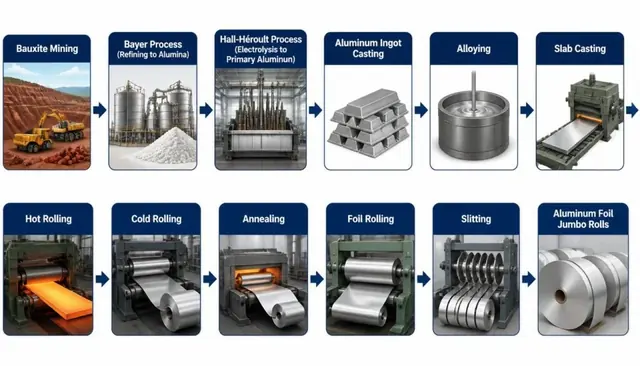
The aluminum foil supply chain is the complete sequence of processes that transform raw bauxite ore into the wide, heavy rolls of aluminum foil that converters use to make finished products.
Here's the journey at a glance:
Each step builds on the previous one, and quality issues at any stage cascade downstream
Step 1: Mining Bauxite – The Beginning of the Supply Chain
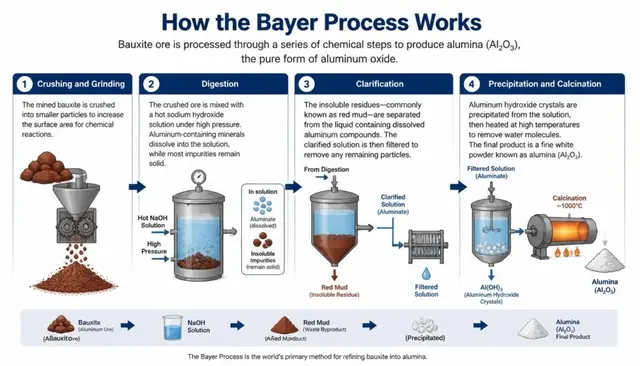
Every aluminum product starts with bauxite , the world's primary source of aluminum.Bauxite is a naturally occurring sedimentary rock rich in aluminum oxides. It forms over millions of years through the weathering of rocks in tropical and subtropical climates.
Unlike finished aluminum, bauxite cannot be used directly. It must first be refined into alumina before aluminum metal can be produced.
Where Is Bauxite Mined?
Several countries dominate global bauxite production due to their abundant natural reserves.
Major bauxite-producing countries include:
Australia
Guinea
China
Brazil
India
Indonesia
Australia and Guinea together account for a significant share of global bauxite exports, supplying refineries and aluminum producers around the world.
Step 2: Refining Bauxite into Alumina
After mining, bauxite is transported to alumina refineries, where it is converted into alumina (Al₂O₃)
the essential raw material used to produce aluminum metal.
This conversion is carried out using the
Bayer Process , a refining method that has been widely adopted for over a century.
Why Alumina Is So Important
Alumina serves as the direct feedstock for aluminum smelters.
Its purity has a significant impact on:
Aluminum purity
Mechanical properties
Rolling performance
Surface quality
Final foil consistency
For manufacturers producing food-grade aluminum foil, maintaining high-purity alumina throughout the process is essential to achieving stable product quality.
Step 3: Producing Primary Aluminum
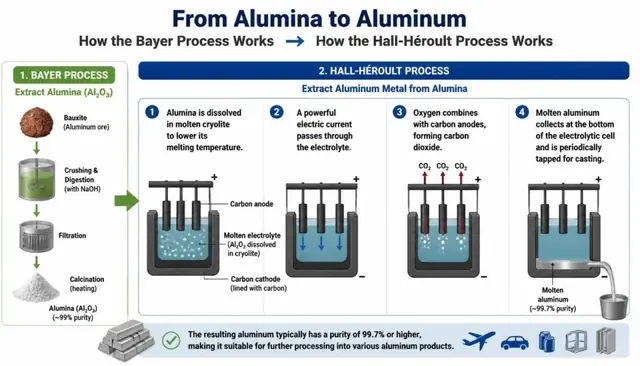
Once alumina has been refined, the next step is converting it into pure aluminum metal. This is achieved through the
Hall-Héroult Process , the world's standard method for producing primary aluminum.
The process uses electricity to separate aluminum from oxygen in molten alumina. Because aluminum does not exist naturally in its metallic form, electrolysis is required to extract the pure metal.
From Molten Aluminum to Aluminum Ingots
After electrolysis, molten aluminum is cast into different forms depending on its intended application.
Common products include:
Primary aluminum ingots
Rolling slabs
Billets
Wire rods
For aluminum foil production, large rolling slabs are the preferred starting material because they can withstand multiple rolling stages while maintaining excellent structural consistency.
Primary Aluminum vs. Recycled Aluminum
Modern aluminum production increasingly incorporates recycled material, helping reduce both costs and carbon emissions.
Primary Aluminum
Recycled Aluminum
Produced directly from alumina
Produced by remelting aluminum scrap
Higher purity
Quality depends on scrap sorting and refining
Excellent consistency
May require additional alloy adjustments
Preferred for demanding foil applications
Widely used in many industrial products
For food-grade aluminum foil , many manufacturers use a carefully controlled combination of primary aluminum and high-quality recycled aluminum. Advanced refining and filtration technologies ensure the final composition meets strict industry standards while supporting sustainability goals.
Step 4: Alloying Aluminum for Different Foil Applications
Pure aluminum is relatively soft. To achieve the strength, formability, and performance required for different applications, manufacturers add controlled amounts of alloying elements such as:
Iron (Fe)
Silicon (Si)
Manganese (Mn)
Magnesium (Mg)
These elements create different aluminum alloys, each designed for specific end uses.
Selecting the right alloy is one of the most important decisions in aluminum foil production, as it determines the foil's mechanical properties, forming performance, corrosion resistance, and suitability for various industries.
Aluminum Foil Alloy Comparison
Alloy
Main Features
Typical Applications
8011
Excellent formability, corrosion resistance, food-safe
Household foil, food wrapping, pop-up sheets
3003
Higher strength, good deep drawing
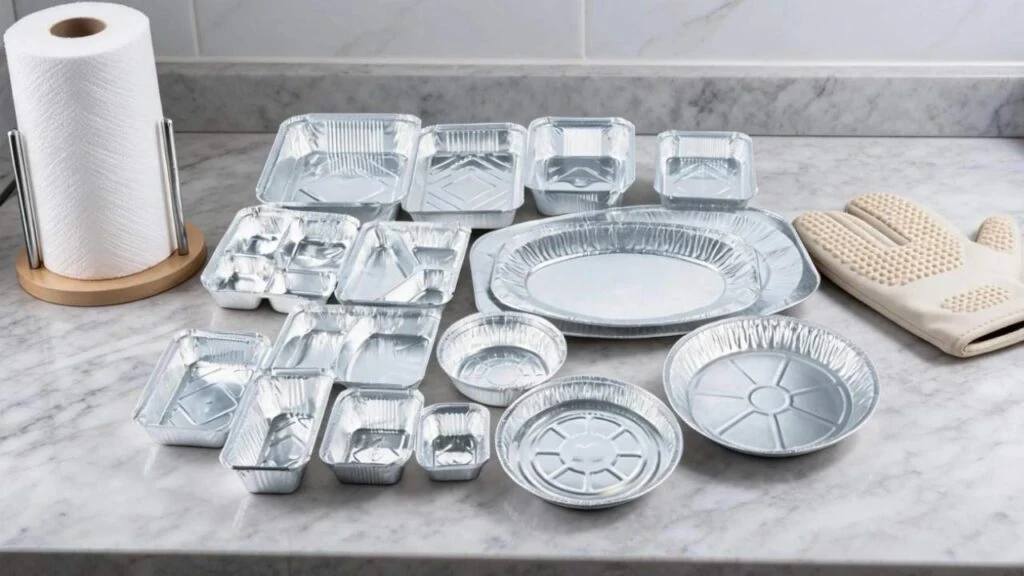
Food containers, small trays
3004
Recycled aluminum foil scraps and tins
Heavy-duty containers, large trays
8006
Excellent elongation, wrinkle-free forming
Premium wrinkle-free foil containers
8079
Ultra-thin, highly flexible
Pharmaceutical foil, flexible packaging
Choosing the Right Alloy
There is no single "best" aluminum foil alloy. The ideal choice depends on your product requirements.
When selecting an alloy, buyers should consider factors such as:
Product design
Container size
Forming complexity
Thickness
Surface finish
End-use industry
Production equipment compatibility
For example:
A household foil converter may prioritize the versatility of
8011
A food container manufacturer may choose
3003 ,
3004 , or
8006 depending on the container design.
A pharmaceutical packaging producer will often require
8079 for its superior barrier properties and flexibility.
Working closely with an experienced aluminum foil supplier can help ensure the selected alloy matches both your production process and your customers' performance expectations.
Understanding these differences allows buyers to source more effectively, avoid unnecessary costs, and achieve consistent product quality over the long term.
Step 5: Rolling Aluminum into Foil
After the aluminum alloy has been cast into large slabs, the material enters the most critical stage of foil manufacturing:
rolling
The goal is to gradually reduce the aluminum from several hundred millimeters thick to a foil that may be only
0.006–0.2 mm thick.
This reduction cannot be achieved in a single step. Instead, manufacturers use a series of rolling processes with progressively tighter thickness control.
1. Hot Rolling
The cast slab is first heated and passed through large rolling mills.
Purpose of hot rolling:
Reduce slab thickness significantly
Improve internal structure
Eliminate casting defects
Prepare the material for cold rolling
After hot rolling, the material becomes a thick aluminum coil rather than a rigid slab.
2. Cold Rolling
The coil is then rolled at room temperature through multiple rolling stands.
Cold rolling provides:
More precise thickness control
Better surface finish
Improved flatness
Higher production consistency
Several rolling passes are usually required, with the thickness gradually reduced at each stage.
3. Foil Rolling
When the material becomes extremely thin, it enters the foil rolling stage
At this point, the aluminum is often rolled two sheets together
(known as double rolling
) because a single sheet would be too fragile.
This process creates:
A bright side (contacting the polished roll)
A matte side (contacting the other foil sheet)
This is why many aluminum foil products have one shiny side and one dull side.
Step 6: Annealing and Surface Treatment
After rolling, the foil is usually too hard for many applications.
It therefore undergoes annealing , a controlled heat treatment process.
What Annealing Does
Annealing helps:
Restore softness
Improve ductility
Enhance deep drawing performance
Reduce internal stress
This step is especially important for food container foil , which must be formed into trays and containers without cracking.
Understanding O Temper and H Temper
Temper
Characteristics
O Temper
Fully annealed, very soft, excellent formability
H Temper
Strain-hardened, higher strength
Cleaning and Food-Grade Requirements
During rolling, lubricants are used to reduce friction.
Before shipment, manufacturers carefully control:
Residual oil levels
Surface cleanliness
Odor
Food-contact compliance
For food packaging applications, cleanliness standards are particularly strict.
Step 7: Slitting into Aluminum Foil Jumbo Rolls
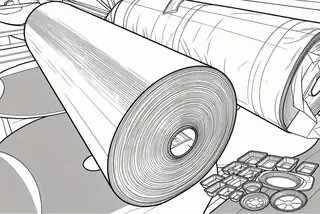
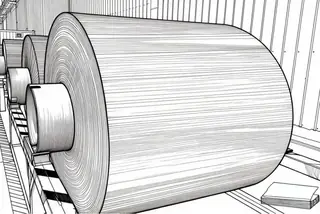
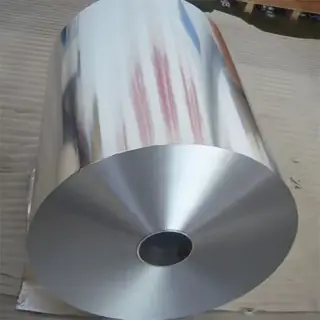
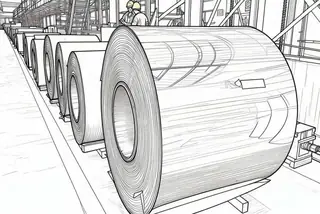
Once the foil reaches its final thickness and temper, it is slit into aluminum foil jumbo rolls
These jumbo rolls are the raw material used by downstream converters.
Typical Jumbo Roll Specifications
Parameter
Typical Range
Thickness
0.006–0.2 mm
Width
Custom according to application
Have a project like this?
We source the machinery, audit the factory and inspect the goods before they ship.
Ask a question Email usMore on Materials & Alloys
- 3003 H24 vs 8011 H22: Choosing the Right Aluminum Foil for Container Manufacturing
- 8006 O Aluminum Foil: The Best Choice for Wrinkle-Free Aluminum Foil Containers
- 8011 O Aluminum Foil Jumbo Rolls: Features, Thickness, Width and Common Applications
- How to Source Aluminum Foil Jumbo Rolls for Household Foil Production?
Related equipment and products
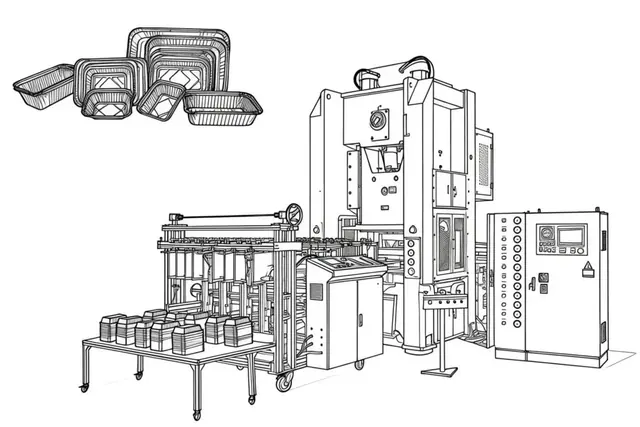
Aluminum Foil Container Making Machine
High-speed press line that converts aluminum foil jumbo rolls into finished food containers automatically.
View details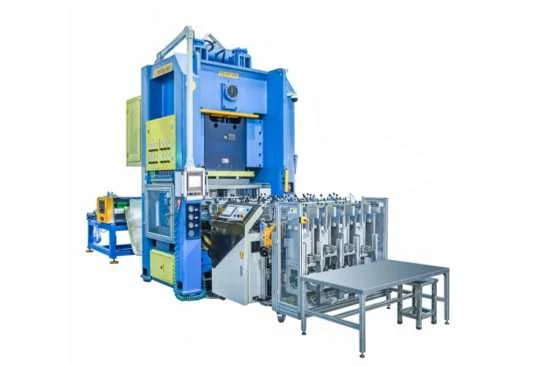
C-Frame Foil Container Machine
C-frame press configuration for aluminum foil container forming, with open access on three sides.
View details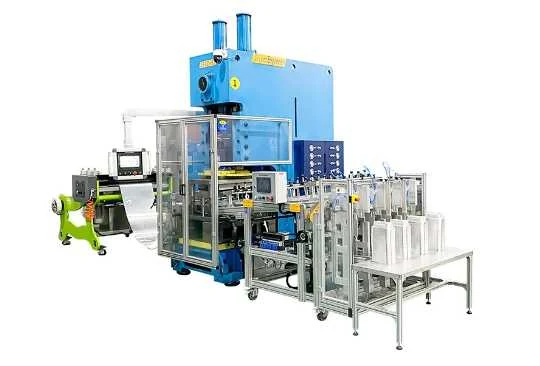
H-Frame Foil Container Press
Closed H-frame press built for heavier, higher-tonnage aluminum foil container forming.
View detailsTurn this into a project
Send us your target product and market. We come back with the factory shortlist and what it costs to verify them.