
Wired and Wireless RF Thermostats Compared
Wireless is not automatically better. It solves one specific problem, and it introduces two of its own.
The problem wireless solves
When the appliance sits in a plant cupboard, a riser or a remote manifold, running a control cable through finished walls can cost more than the thermostat. An RF pair removes that work entirely.
Why 868 MHz and not 2.4 GHz
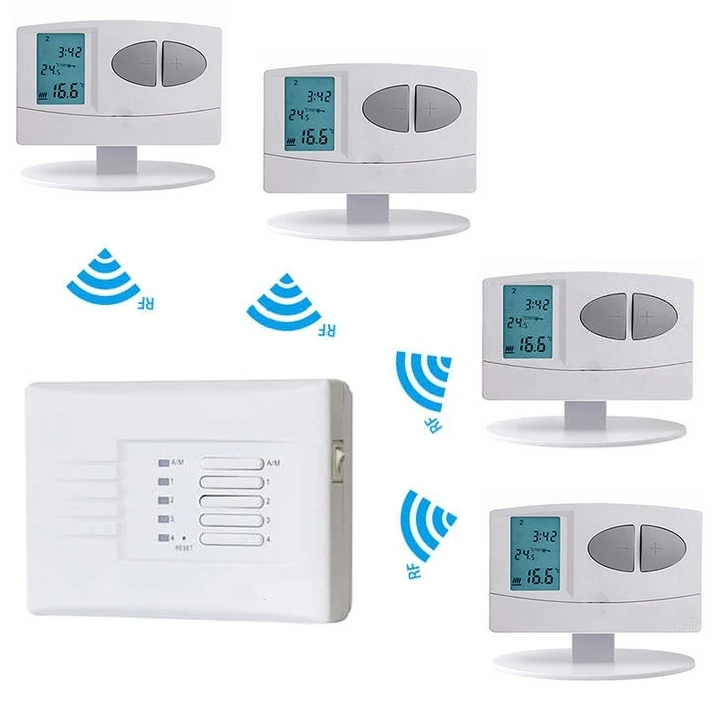
Our RF models operate at 868.35 MHz. That band is not shared with WiFi and Bluetooth traffic, which is why the specification describes it as giving more stable communication. Transmission distance is approximately 200 m in open terrain on several models.
What wireless costs you
A pair has to be bound and walk tested, and the room unit depends on its batteries. Every wireless model in our range carries a low battery indicator for exactly that reason, and several add an LED system indicator at the receiver so a technician can see whether a call for heat arrived.
When wired is still the right answer
If a cable already runs to the appliance, a wired stat removes the commissioning step and the battery dependency. On large estates it also removes the job of replacing batteries in every room.
The third option
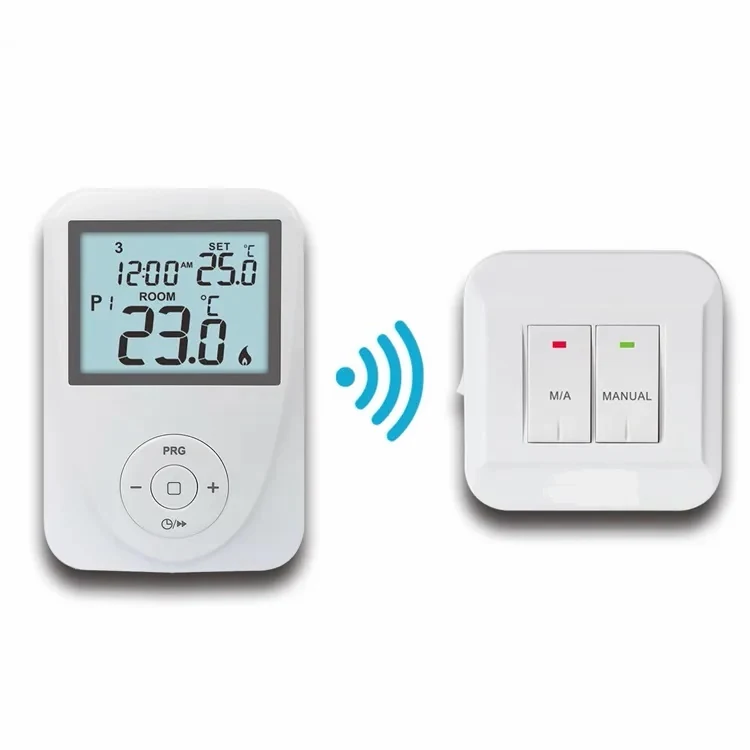
The WIFIRF models combine both: an 868.35 MHz link between the room unit and the receiver, plus a WiFi module in the receiver for app control. The heating keeps running on the RF link when the internet fails.
Questions On This Topic
How far will the link reach in a real building?
The 200 m figure is open terrain. Internal walls, metal studwork and foil backed insulation reduce it, so walk test before final fixing.
Will the receiver still work if the room unit battery dies?
The low battery indicator warns first. Replace the cells before it reaches that point.
Can one room unit drive several zones?
Yes. The C7RF controls up to four zones independently or simultaneously.
Need This Checked Against Your System?
Send the equipment details on WhatsApp and we will confirm which of our models matches before you order.