
Single Sprocket Curve Roller Conveyor
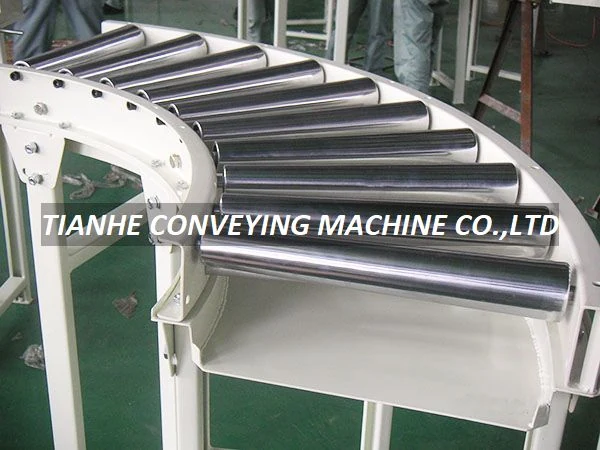
The Single Sprocket Curve Roller Conveyor is a chain-driven conveyor designed for indoor use with products that have flat bottoms. It features adjustable leg height, a roller size of 42.7 mm small end diameter by 57–80 mm big end diameter by 12 mm shaft diameter, and a roller width ranging from 300 to 800 mm. The conveyor has a frame size of 120 mm height by 30 mm width by 3.2 mm thickness, a sprocket inner radius of 900 mm, and a maximum conveying capacity of 150 kg per set at a top speed of 25 m/min. It is available with motor power options of 0.2 kW or 0.4 kW.

Product Overview
The Single Sprocket Curve Roller Conveyor is a chain-driven conveyor designed for indoor use with products that have flat bottoms. It features adjustable leg height, a roller size of 42.7 mm small end diameter by 57–80 mm big end diameter by 12 mm shaft diameter, and a roller width ranging from 300 to 800 mm. The conveyor has a frame size of 120 mm height by 30 mm width by 3.2 mm thickness, a sprocket inner radius of 900 mm, and a maximum conveying capacity of 150 kg per set at a top speed of 25 m/min. It is available with motor power options of 0.2 kW or 0.4 kW.
Part of the Roller Conveyor range, used in Warehouse and Distribution Centres.
Key Benefits
- Chain-driven operation ensures reliable power transmission for curved paths
- Adjustable leg height allows for level installation on uneven floors
- Conveyor width can be set to match product dimensions with a standard 90 mm overhang on each side
- Roller pitch available in 100 mm or 150 mm for flexible layout design
- Maximum speed of 25 m/min supports efficient material flow in production lines
Application Scenarios
- Curved transfer sections in automated assembly lines where products must follow a turn without stopping
- Indoor material handling systems in warehouses or factories with limited space
- Conveyor integration at the end of a straight line where a product needs to change direction
- Assembly stations requiring a smooth, continuous curve to move parts between work positions
- Production lines with tight space constraints where a compact curved conveyor reduces footprint
Who It Is For
- Conveyor system integrators building custom curved sections into larger lines
- Industrial equipment builders designing compact transfer points for factory automation
- Warehouse and logistics contractors installing indoor conveyors for product routing
- Assembly line builders needing a reliable curve section with adjustable height
- Manufacturers sourcing cost-effective conveyors with consistent roller dimensions
Problems It Solves
- Need for a curved conveyor that can be integrated into a straight line without complex alignment
- Difficulty in maintaining product stability when changing direction on a flat or poorly supported curve
- Lack of adjustable height in standard conveyors leading to misalignment on uneven floors
- Inconsistent roller spacing or diameter causing product jamming or tipping
- High cost of custom curved conveyors when a standard, modular solution is sufficient
Technical Features
- Chain-driven design with a single sprocket for consistent power transfer around curves
- Adjustable leg height to compensate for floor irregularities and ensure level operation
- Roller size of 42.7 mm small end diameter, 57–80 mm big end diameter, and 12 mm shaft diameter for compatibility with standard shafts
- Roller width from 300 to 800 mm to suit a range of product sizes
- Roller pitch of 100 mm or 150 mm for layout flexibility and load distribution
- Frame size of 120 mm height, 30 mm width, and 3.2 mm thickness for structural rigidity
- Sprocket inner radius of 900 mm for smooth curve performance
- Maximum conveying capacity of 150 kg per set to support medium-weight loads
- Maximum speed of 25 m/min for efficient throughput in production environments
Materials
- Steel frame and rollers for durability in industrial environments
- Chain and sprocket components for reliable power transmission
- Shaft and roller bearings designed for consistent rotation under load
Quality Control
- Roller shafts checked for concentricity and smooth rotation before assembly
- Chain drive tension verified to prevent slippage or excessive wear
- Frame dimensions measured against the 120 mm height, 30 mm width, and 3.2 mm thickness specification
- Adjustable legs tested for secure locking at multiple height positions
- Conveyor tested at maximum speed to confirm stable operation
Customization Options
- Roller width selected between 300 mm and 800 mm to match product footprint
- Roller pitch chosen between 100 mm and 150 mm for layout compatibility
- Motor power selected between 0.2 kW and 0.4 kW based on required throughput
- Conveyor width adjusted by adding 90 mm to the roller width for edge clearance
- Frame height adjusted via leg mechanism to suit site floor conditions
Use Guide
- Ensure the product bottom is flat and stable to prevent tipping on the curve
- Set the conveyor height to match adjacent lines or workstations for smooth transfer
- Verify that the roller width is sufficient to support the full product width with 45 mm clearance on each side
- Select motor power based on the total weight of the load and desired speed
- Use the 90 mm overhang on each side to prevent product from falling off the edges
Specifications
| Model No | KTR-900 |
|---|---|
| Roller Size | 42.7 mm x 57–80 mm x 12 mm |
| Roller Width | 300–800 mm |
| Roller Pitch | 100 mm or 150 mm |
| Frame Size | 120 mm x 30 mm x 3.2 mm |
| Sprocket Inner Radius | 900 mm |
| Conveyor Width | Roller W + 90 mm |
| Conveyor Height | Min 450 mm |
| Conveying Capacity | Max 150 kg per set |
| Speed | Max 25 m/min |
| Motor Power | 0.2 kW or 0.4 kW |
Manufacturing Process
Step 1
Fabrication of the frame from steel sheet with precision cutting and bending
Step 2
Assembly of rollers onto shafts with proper alignment and bearing installation
Step 3
Mounting of the sprocket and chain drive system to the frame
Step 4
Installation of adjustable legs with locking mechanism
Step 5
Final inspection of roller rotation, chain tension, and frame stability
Compared With Other Options
| Pneumatic or belt-driven curved conveyors | Chain-driven operation provides consistent torque and better control on curves, especially under load |
|---|---|
| Multiple straight conveyors with manual turntables | A single curved conveyor eliminates the need for intermediate transfer points and reduces floor space |
| Custom welded curved conveyors | Standardized components and modular design reduce lead time and cost compared to bespoke fabrication |



Single Sprocket Curve Roller Conveyor Questions
What is the maximum load capacity of the conveyor?
The maximum conveying capacity is 150 kg per set.
Can the height be adjusted?
Yes, the leg height is adjustable to accommodate uneven floors.
What motor power options are available?
The conveyor is available with 0.2 kW or 0.4 kW motor power.
What roller pitch options are offered?
Roller pitch is available in 100 mm or 150 mm intervals.
Is the conveyor suitable for outdoor use?
It is designed for indoor applications only.
How is the conveyor width determined?
Conveyor width is the roller width plus 90 mm (45 mm on each side).
What is the maximum speed?
The maximum speed is 25 m/min.
Get a Price for Single Sprocket Curve Roller Conveyor
Send the quantity and any material or surface option you need, and a quotation comes back against this model number.