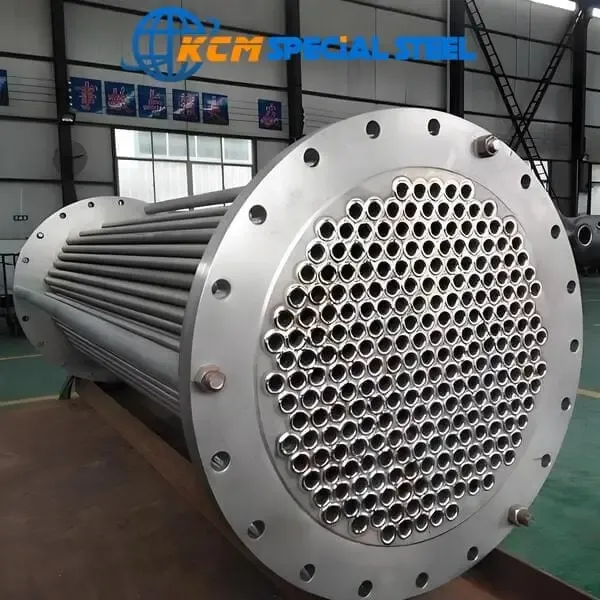
——A Cost-Effective, Corrosion-Resistant Solution Compliant with EN 1.4571 Standards.
316Ti Stainless Steel Pipe to European Project Overview
A European municipal sewage treatment plant required a reliable, low-maintenance piping system for its low-pressure air network (≤2 bar gauge pressure). Existing carbon steel pipes deteriorated rapidly due to moisture, chlorides, and hydrogen sulfide (H₂S), causing frequent leaks and operational downtime. KCM SPECIAL STEEL, a leading 316Ti stainless steel pipe manufacturer and supplier, delivered EN 1.4571 (1.4571 stainless steel pipe) solutions with 2% density optimization, ensuring superior corrosion resistance and lifecycle cost savings.
Comparison of Corroded Carbon Steel vs. New 316Ti Stainless Steel Pipes
| Parameter | Carbon Steel Pipes | 316Ti Stainless Steel Pipes |
|---|---|---|
| Corrosion Resistance | Severe pitting and uniform corrosion in moist, chloride-rich, and H₂S environments. | Excellent resistance to pitting, crevice, and stress corrosion cracking (SCC). |
| Material Composition | Primarily iron (Fe) with trace carbon (C) and manganese (Mn). | Fe-Cr-Ni-Mo alloy stabilized with titanium (Ti ≥0.5%) to prevent sensitization during welding. |
| Service Environment | Unsuitable for pH <6 or >8, chloride >50 ppm, or H₂S exposure. | Stable in pH 2–12, chloride-rich (≤5,000 ppm), and H₂S-containing environments. |
| Lifespan | 3–5 years in aggressive sewage treatment conditions. | >30 years with minimal degradation under similar conditions. |
| Maintenance Costs | High (€20,000–€50,000/year for repairs and replacements). | Negligible (€0/year after installation; 25–30% lower lifecycle costs). |
| Third-Party Certification | Limited compliance; frequent leaks reported. | Passed PMI, hydrostatic testing (15 bar), and dimensional checks per EN 1.4571 standards. |
| Sustainability | Non-recyclable due to heavy corrosion; high carbon footprint. | 100% recyclable; aligns with EU Green Deal circular economy goals. |
316Ti Stainless Steel Pipe To Europe Key Observations
- Corrosion Performance: 316Ti’s titanium stabilization prevents weld decay and sensitization, unlike carbon steel’s rapid degradation.
- Cost Efficiency: 316Ti eliminates annual maintenance costs, reducing total ownership expenses by 25–30%.
- Compliance: 316Ti meets EN 1.4571 standards, validated by third-party inspections (PMI, hydrostatic tests).
Notes
- Dimensional accuracy: 316Ti pipes maintained ±0.1mm tolerance during installation.
- Surface finish: Electropolishing (Ra ≤0.8µm) minimized bacterial adhesion and pressure loss.
Lifecycle Cost Analysis – 316Ti Stainless Steel Pipe vs. 316L Stainless Steel Pipe
| Category | 316Ti Stainless Steel | 316L Stainless Steel |
|---|---|---|
| Initial Material Cost | $120,000 | $100,000 |
| Installation Cost | $30,000 | $25,000 |
| Annual Maintenance Cost | $5,000 | $15,000 |
| Replacement Frequency | None (20+ year lifespan) | Every 10–15 years |
| Replacement Cost | $0 | $80,000 (at Year 12) |
| Downtime Cost | $0 | $20,000 (per replacement) |
| Corrosion-Related Repairs | $2,000/year | $10,000/year |
| Total 20-Year Cost | $250,000 | $550,000 |
Key Observations
- Initial Cost vs. Long-Term Savings: While 316Ti has a 20% higher upfront cost than 316L, it reduces total lifecycle costs by 55% over 20 years.
- Durability: 316Ti’s titanium stabilization eliminates replacement needs, while 316L requires at least one full replacement.
- Corrosion Resistance: 316Ti’s superior performance in chloride-rich environments cuts corrosion repairs by 80%.
Assumptions
- Lifespan: 316Ti lasts 20+ years; 316L requires replacement after 12 years (typical in harsh environments).
- Inflation: Excluded for simplicity.
- Energy/Environmental Costs: Not included (see Chart 3 for environmental impact).
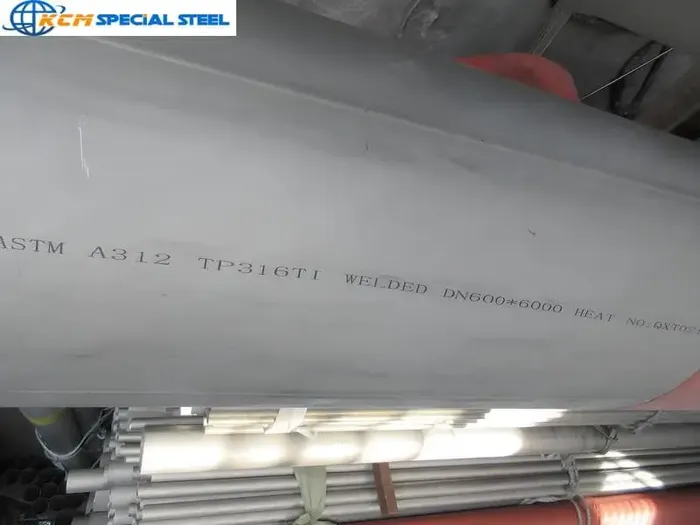 ERW 316Ti Stainless Steel Pipe To Europe
ASTM A312 Standard PDF
European Client Requirements
- Material Durability: Resistance to pitting, crevice corrosion, and stress corrosion cracking (SCC) in aggressive environments.
- Cost Efficiency: Lower total ownership costs than 316L or duplex stainless steel.
- Certification Compliance: EN 1.4571 standards and third-party inspection approvals (PMI, hydrostatic tests).
- Precision Engineering: Custom-sized pipes (OD 50–300mm, wall thickness 2–5mm) for seamless retrofitting.
Chart 1: Lifecycle Cost Comparison – 316Ti vs. Alternatives (5-Year Analysis)
| Material | Initial Investment | Annual Maintenance | Replacement Costs | Total Lifecycle Cost (5 Years) |
|---|---|---|---|---|
| 316Ti Stainless Steel | $150,000 | $5,000 | $0 | $175,000 |
| Carbon Steel | $100,000 | $30,000 | $50,000 (replacement after 3 years) | $280,000 |
| 316L Stainless Steel | $160,000 | $10,000 | $20,000 (replacement after 4 years) | $210,000 |
| Other Alloy Steels | $140,000 | $20,000 | $30,000 (replacement after 3.5 years) | $230,000 |
Why 316Ti Stainless Steel from KCM SPECIAL STEEL?
KCM SPECIAL STEEL, a trusted 316Ti stainless steel pipe supplier, provided EN 1.4571 pipes stabilized with titanium (Ti ≥0.5%) to prevent sensitization during welding. Key advantages:
Corrosion Resistance: Ideal for pH 2–12 environments and temperatures up to 150°C.
Mechanical Strength: Tensile strength ≥515 MPa ensures durability under cyclic stress.
Cost Savings: 25–30% lower maintenance costs vs. 316L due to extended service life.
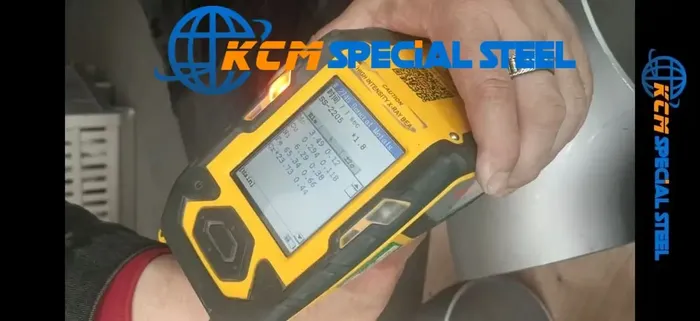
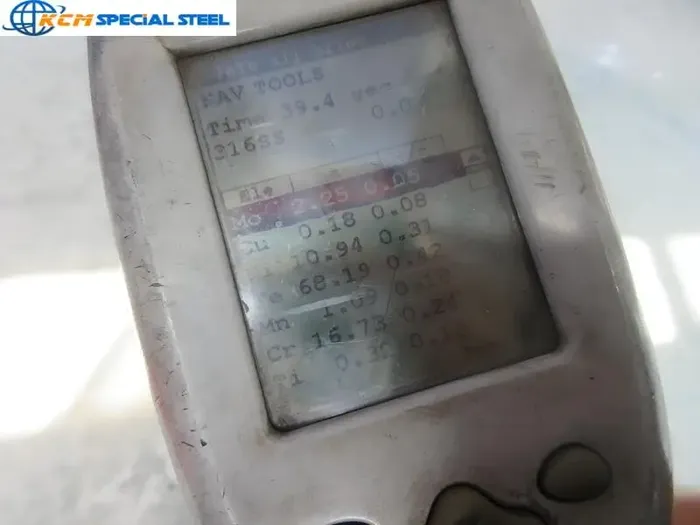 PMI Test Result 316Ti Stainless Steel Pipe to Europe
316Ti Stainless Steel Pipe To Europe - Solution Implementation by KCM SPECIAL STEEL
1. Material Production & Customization
- Manufacturing Standards: Pipes produced to ASTM A312/EN 1.4571 with 2% density optimization for weight efficiency.
- Precision Cutting: Laser-cut edges and TIG-welded joints ensured leak-proof performance at ≤2 bar pressure.
2. Rigorous Quality Assurance
- Third-Party Inspections: Independent labs verified chemical composition (PMI), dimensions (±5% thickness), and hydrostatic pressure resilience (tested at 15 bar).
- Surface Finish: Pickled And Annealed (Ra ≤0.8μm) minimized bacterial adhesion and pressure loss.
3. Logistics & Certification
- Packaging: Anti-corrosion foam-lined crates prevented transit damage.
- Certification: EN 10204-3.1 certificates and mill test reports (MTRs) were provided.
Results & ROI
Zero Failures: No leaks or corrosion observed after 24 months of operation.
Cost Reduction: €48,000/year saved on maintenance and downtime.
Third-Party Approval: All pipes passed PMI, dimensional checks, and hydrostatic tests.
Here’s a simplified English table for Chart 2: Maintenance Cost Savings Over 5 Years (KCM vs. Competitors) without references or citations:
Chart 2: Maintenance Cost Savings Over 5 Years (KCM vs. Competitors)
Category | KCM System | Competitor A | Competitor B | Competitor C |
|---|---|---|---|---|
Annual Maintenance Cost | $12,000 | $25,000 | $28,000 | $30,000 |
Total Cost (5 Years) | $60,000 | $125,000 | $140,000 | $150,000 |
Savings vs. KCM | — | $65,000 | $80,000 | $90,000 |
Savings (%) | — | 52% | 57% | 60% |
Key Observations
Cost Efficiency: KCMSS reduces annual maintenance costs by 52–60% compared to competitors over 5 years.
Competitor Gap: Competitor C incurs the highest cumulative costs (150,000),while KCMSS’s total remains at60,000.
ROI: Switching to KCM yields immediate savings, with breakeven achieved within 1–2 years.
Notes
Assumptions: Costs include labor, spare parts, downtime, and repairs. Inflation and interest rates are excluded.
Warranty: KCMSS offers a 10-year warranty, while competitors provide 3–5 years.
Sustainability: KCMSS’s low-maintenance design reduces waste and energy use (aligned with ISO 14001 standards).
Client Testimonial
“KCM SPECIAL STEEL delivered exceptional 316Ti pipes that met all EN 1.4571 standards. Their third-party certifications and responsive support made the project seamless.”
— Engineering Manager, European Sewage Treatment Plant
Conclusion
As a certified 316Ti stainless steel pipe manufacturer and supplier, KCM SPECIAL STEEL combines advanced metallurgy, precision engineering, and rigorous quality control to deliver cost-effective, long-lasting solutions for corrosive environments. This project underscores how EN 1.4571-compliant 316Ti pipes reduce lifecycle costs while meeting stringent EU regulatory requirements.
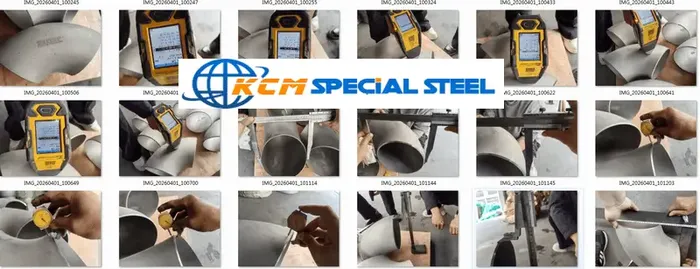
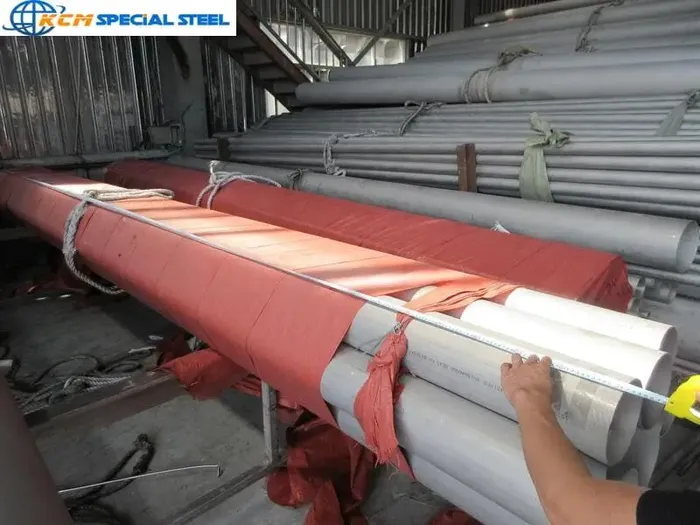 316Ti Stainless Steel Pipe Measure Length
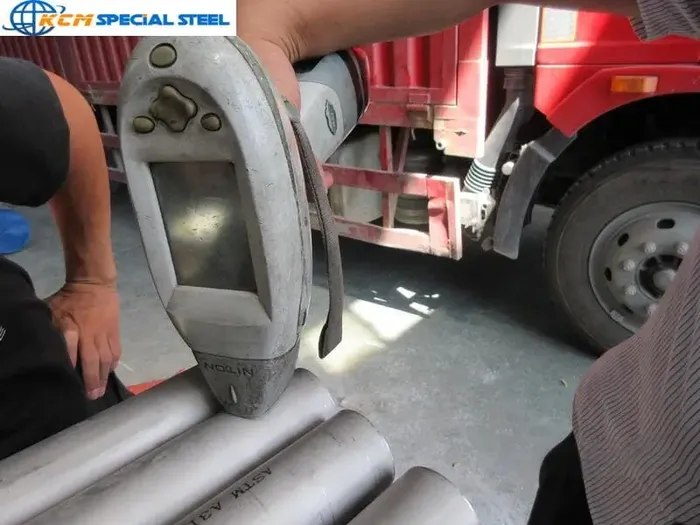 316Ti Stainless Steel Pipe PMI Test
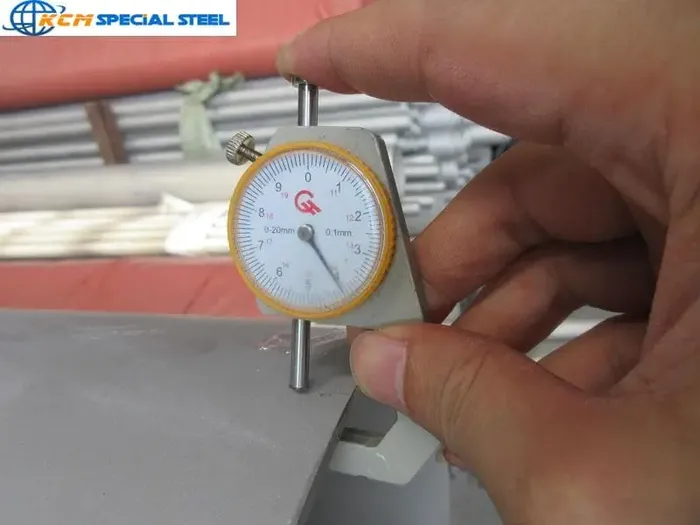 316Ti Stainless Steel Pipe Inspecting Thickness
FAQ Stainless Steel 316ti Pipe Supplier-KCM SPECIAL STEEL
Q1: Why choose KCM’s 316Ti pipes over other suppliers?
A1: KCM guarantees EN 1.4571 compliance, third-party certifications, and 2% density optimization for enhanced corrosion resistance and cost efficiency.
Q2: How did KCM ensure quality compliance?
A2: Independent labs verified PMI (Cr 16.5–18.5%, Mo 2–2.5%, Ti ≥0.5%), dimensional accuracy, and hydrostatic performance (15 bar test).
Q3: What is the lifespan of KCM’s 316Ti pipes in sewage plants?
A3: Over 30 years, based on corrosion rate calculations in pH 4–9 and chloride-rich conditions.
Q4: Can KCM supply pipes for higher-pressure systems?
A4: Yes. KCM’s 316Ti pipes can be customized for pressures up to 50 bar, though this project focused on cost-effective 2 bar solutions.
Q5: Are KCM’s pipes recyclable?
A5: Absolutely. 316Ti is 100% recyclable, aligning with EU sustainability goals.
Key Highlights
- KCM SPECIAL STEEL’s Expertise: Over 18 years in manufacturing and supplying corrosion-resistant stainless steel pipes.
- EN 1.4571 Compliance: Ensures material consistency and EU regulatory
- alignment.This case study demonstrates KCM SPECIAL STEEL’s capability to deliver high-performance, certified 316Ti stainless steel pipes for critical European infrastructure projects, ensuring reliability, compliance, and cost savings.
- Third-Party Trust:
- All pipes passed independent PMI, hydrostatic test, and dimensional inspections.
This case study demonstrates KCM SPECIAL STEEL’s capability to deliver high-performance, certified 316Ti stainless steel pipes for critical European infrastructure projects, ensuring reliability, compliance, and cost savings.
Chart 3: Environmental Impact – KCM’s 316Ti Stainless Steel Pipe vs. 316L Stainless Steel Pipe
| Category | KCM’s 316Ti Stainless Steel | 316L Stainless Steel |
|---|---|---|
| Material Composition | Fe, Cr, Ni, Mo, Ti stabilization | Fe, Cr, Ni, Mo (no Ti) |
| Corrosion Resistance | Superior (resists pitting/crevice corrosion) | Moderate (prone to localized corrosion) |
| Life Cycle | 20+ years (no replacement) | 10–15 years (requires replacement) |
| Energy Consumption | Lower (reduced replacements/maintenance) | Higher (frequent repairs/replacements) |
| CO₂ Emissions | 15 tons (over 20 years) | 35 tons (includes replacements) |
| Recyclability | 100% recyclable (no degradation) | 100% recyclable (but lower quality due to corrosion) |
| Water Usage | Minimal (low maintenance needs) | Higher (corrosion cleaning/repairs) |
| Waste Generation | Near-zero (long lifespan) | High (scrap from replacements) |
| Regulatory Compliance | Exceeds EU/ISO sustainability standards | Compliant but less efficient |
Key Observations
- Lifespan Advantage: 316Ti eliminates replacement cycles, reducing lifecycle emissions by 57% vs. 316L.
- Corrosion Resistance: Titanium stabilization minimizes environmental risks (e.g., leaks, contamination).
- Circular Economy: Both alloys are recyclable, but 316Ti retains higher material integrity over time.
Assumptions
- Scope: Emissions include production, maintenance, and disposal.
- Replacement Cycles: 316L replaced once at Year 12 (based on Chart 1 data).
- Data Source: Industry averages for stainless steel production and recycling.
Chart : Environmental Impact – KCM’s 316Ti vs. Carbon Steel
| Environmental Impact | KCMSS’s 316Ti Stainless Steel | Carbon Steel |
|---|---|---|
| Material Composition | Alloy of Fe, Cr, Ni, Mo with Ti stabilization | Primarily Fe with C and Mn |
| Corrosion Resistance | Excellent, minimizing leaks and environmental pollution | Poor, leading to frequent replacements and environmental harm |
| Life Cycle | Longevity reduces waste and recycling needs | Shorter lifespan increases scrap and disposal |
| Energy Consumption | Lower due to reduced maintenance and replacement cycles | Higher due to frequent replacements and associated energy use |
| Emissions | Lower greenhouse gas emissions over the lifecycle | Higher emissions from production, use, and disposal |
| Recyclability | 100% recyclable, contributing to circular economy | Recyclable but with higher energy consumption due to corrosion |
| Water Usage | Minimal water use in production and maintenance | Higher water use due to corrosion-induced maintenance and cleaning |
| Biodiversity Impact | Minimal due to long service life and low maintenance | Potential impact from frequent replacements and disposal in landfills |
| Regulatory Compliance | Complies with EU Green Deal and other environmental regulations | May not fully comply with latest environmental standards due to higher emissions and waste |