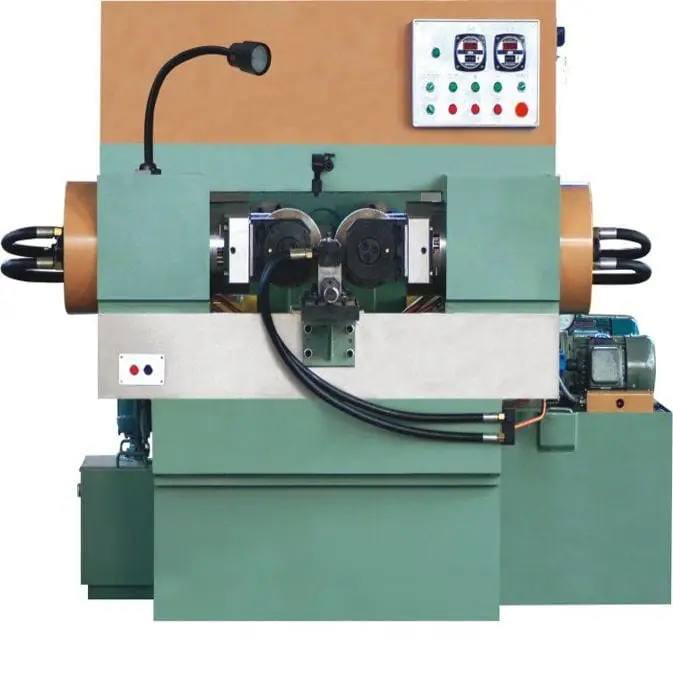
Hydraulic Circling Thread Rolling Machine
Double roller wheels rod parts automatic material loading circling thread making machine
Improved surface condition (which can be further improved by burnishing). Increased mechanical strength by work hardening (see below), by avoiding fracture…
- Built by Ningbo Anchors Precision Machinery Co., Ltd. in Ningbo, China
- More than twenty years experience in cold and hot forging and metal stamping equipment
- Rapid response technical team for operation guidance and production support
Watch Machine Video
WHAT’S COLD ROLLING?
Rolling is the term used to designate forming (generally cold) of a round part (cylindrical or tapered) by tools, rotating or otherwise, in various numbers and arrangements around the work-piece. Forming can also be carried out at medium temperature on certain materials (in the aeronautical industry in particular). Rolling is used increasingly because it brings many advantages compared with machining:
- Improved surface condition (which can be further improved by burnishing).
- Increased mechanical strength by work hardening (see below), by avoiding fracture starts generally due to tool marks or scratches and by fibringobtained on rolling.
- Economy of matter since the blank diameter (the one whose volume corresponds to that of the finished part) is less than that of the finished part (outer diameter).
- Shorter cycle time on machining in many applications (above all on spline rolling).
- Better quality is achieved than with conventional machining: rolling is therefore occasionally used to obtain a better quality than machining and to avoid milling.
TOOLS
There are generally two tools, but one, three or four tools are also regularly used (even more in certain cases). The reason for increasing the number of tools is to reduce the force applied locally to the workpiece in order to avoid deforming it too much (for instance, a hollow part). The tools are generally arranged symmetrically around the workpiece (except in the case of a single tool) to avoid stress on holding the workpiece, and maintains the workpiece in the centre of the tools (no radial movement of the workpiece during forming, an important factor when working long bars or heavy items, for instance).
There are three possible tool shapes:
- Convex: the tools have a circular form with an outer active surface.
- Straight: these are usually called rack or die stock.
- Concave: the tools have a circular shape but with an inner active surface.
HOW IT WORKS
The tool has one (or several) relief profiles and is driven in rotation. Contact between the tool and the workpiece drives the latter in rotation and a mirror profile of the tool is progressively impressed on the workpiece through the force applied to the tools and the variable profile of the tool. Between two tool profiles, the part material is displayed to form the outer diameter of the profile. This displacement is parallel to the surfaces in contact between the tool and the workpiece. It flows all the more easily as the angle between the tool and workpiece contact surfaces and the direction of the force (or the variation of profile) approaches 90°. If not used to develop a profile, displacement of the material can be used to tie two parts. This operation consists of crimping. The tie can be either in translation or in rotation with or without leaktightness between the two workpieces. Certain rolling operations are designed only to create a surface finish on the workpiece or to calibrate a particular shape. In this case, there is no or very little displacement of the material. This is called burnishing or finish rolling (in particular used for the pinions of gear boxes to avoid costly operations such as shaving, grinding or honing).
The rolling cycle breaks down into three parts:
- Penetration: The tool is brought to the workpiece and presses against it either to “print” its profile on the previously smoothed blank, or for burnishing or calibrating the surface.
- Calibration: The workpiece is made round, which is not the case momentarily during penetration.
- Decompression: The tool and the workpiece move apart in order to free the workpiece and machine elasticities. This phase ultimately makes a workpiece circular or otherwise. Failed decompression will induce a “signature” in the part, which is no longer round (visible on measuring its circularity).
Salient Features
Double oil cylinder feed, continuous rolling and flexible graduating; high precision hydraulic ejection pin for tightening workpieces in rolling process for high performance efficiency.
Applicable to involute spline and triangular spline of small module with cold rolling in automobile and motorcycle industries.
Main Technical Parameters
| Double roller wheels rod parts automatic material loading circling thread making machine | ||||||
| Max. rolling pressure | KN | 200 | 320 | |||
| Rolling spline range | Max. diameter | mm | 70 | 70 | ||
| Max. module | mm | 0.75 | 1.25 | |||
| Rolling die range | Max. outer diameter | mm | 178 | 200 | ||
| Aperture | mm | 54 | 75 | |||
| Max. width | mm | 105 | 120 | |||
| Max. center distance btw. main axis | mm | 240 | 270 | |||
| Main axis rotation | r.p.m. | 28.35.45.56 | 19.24.31.40 | |||
| Main axis inclination | ||||||
| Feed travel | mm | 2*7 | 2*7 | |||
| Center height | mm | 900 | 900 | |||
| Gross power | KW | 10.2 | 12.2 | |||
| Dimensions(L*W*H) | mm | 1500*1700*1600 | 2000*1900*1650 | |||
| Packing dimensions(L*W*H) | mm | 2000*2000*1900 | 2250*2000*1900 | |||
| Weight | Kg | 3000 | 3500 | |||
Related Machines
More From Hydraulic Circling Thread Rolling Machine
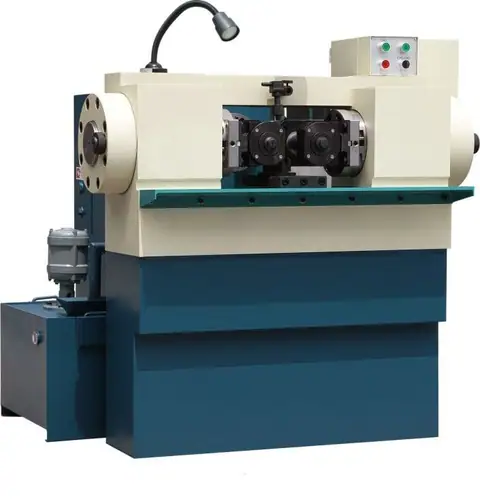 Air valve cock hollow parts three roller wheels automatic hydraulic thread rolling machine
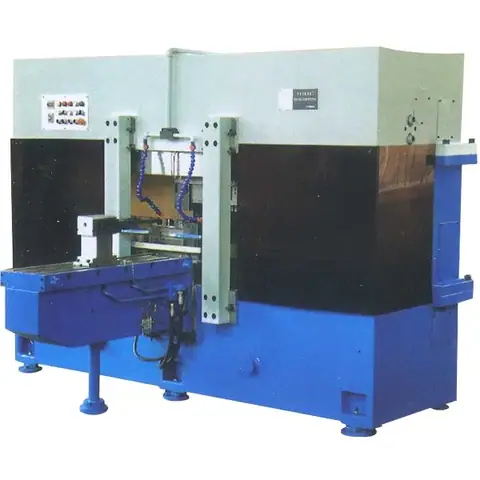 ALC915 Spline Cold Rolling Machine/Torsion Bars Spline Rolling Machine
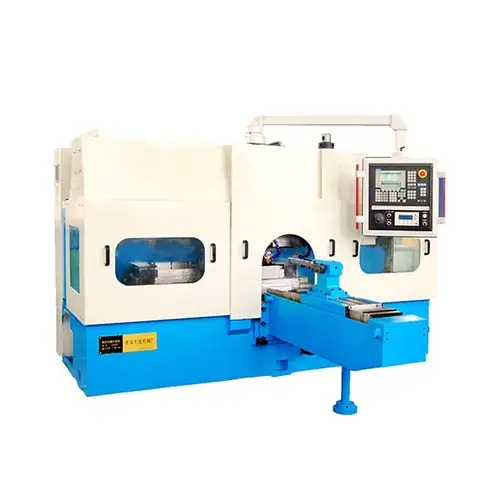 ALC915C CNC Spline Cold Rolling Mill/Torsion Bars Spline Rolling Machine
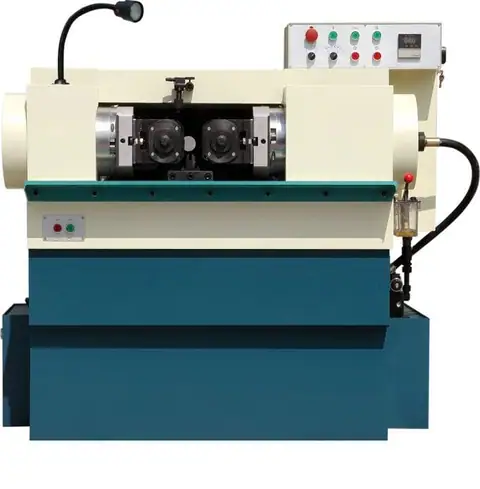 APA28-15 Hydraulic Thread Rolling Machine
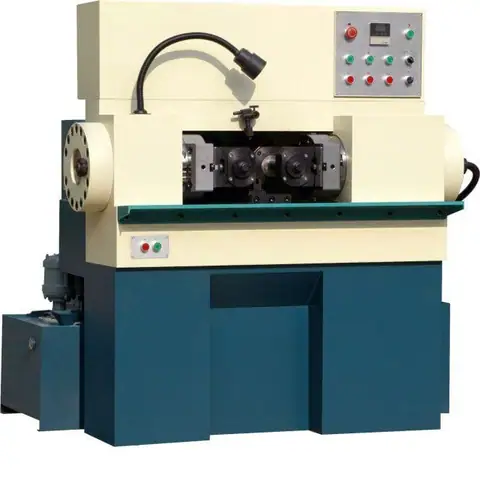 APA28-20 Theead Rod Bar Thread Rolling Machine
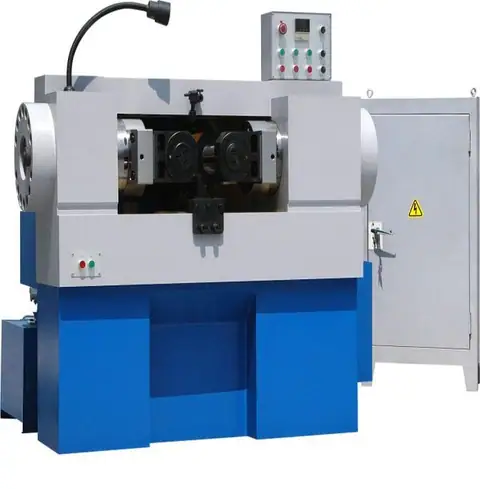 APA28-46 Rod Parts Double Axles Thread Rolling Machine
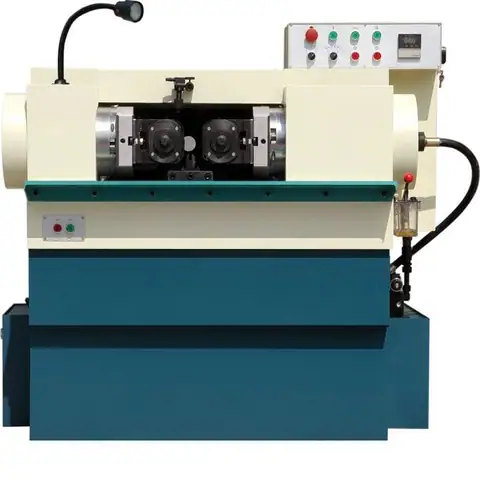 APC28-15 Round Die Hydraulic Thread Rolling Machine
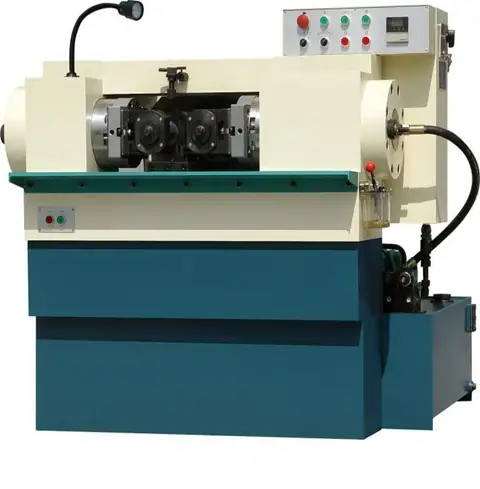 APD28-15 Hydraulic Circling Thread Rolling Machine
Questions About This Machine
Where Is This Machine Made
It is manufactured by Ningbo Anchors Precision Machinery Co., Ltd. in Ningbo, Zhejiang, China, in our own 18,000 square meters workshop with advanced machining equipment.
What Components Are Used In The Machine
We use the world's advanced technology and well-known brands components to ensure high precision and long working life with reliable performance.
Do You Provide Operator Training
Yes. Our professional rapid response technical team instructs machine operation and helps solve problems occurring during production.
Which Countries Do You Export To
Our equipment has been sold to customers all over the world, including Mexico, India, Turkey, Vietnam, Malaysia and South Africa, and many domestic forging and stamping manufacturers in China also use our machines.
How Do I Get A Quotation
Send us your requirement by WhatsApp on +86 185 5689 5898 or email [email protected]. Tell us the fastener or part you want to produce, the size range and the output you need, and we will advise which machine suits.
Tell Us What You Need To Produce
Send your part drawing, size range and target output and our engineers will advise which machine suits your production.