Fittings spoke · High purchase intent
Brass Compression Fittings Buyer Guide: Couplers, Elbows, Tees & Drain-Off Options
Buyers searching brass compression fittings want flame-free joints on copper (and sometimes other tubes) with olive/nut assemblies that warehouses can restock by millimeter size. Here is a factory-faithful map of the compression range published by General Ball Valve Factory, plus an RFQ framework for importers who need purchase-intent detail — not brochure fluff.
Why compression fittings stay on the buy list
Compression joints remain a wholesale staple where soldering is restricted, skills vary on site, or serviceability matters more than permanent sweat joints. A brass body with compression nuts and olives lets technicians remake joints and stock fewer specialty tools than full press ecosystems. For China-sourced programs, the winning supplier is one that can hold OD tolerances across an 8–28 mm ladder, keep nut hexes consistent for branding, and ship packaging that survives container humidity without olive corrosion staining.
General Ball Valve’s compression fittings category sits inside a broader brass catalog — ball valves, pipe fittings, hose fittings, quick couplings, press and PEX lines — so buyers can build a multi-family brass container from one Yuhuan manufacturer rather than juggling five trading companies.
Keyword reality: “brass compression fittings” and “brass compression coupling” both pull commercial traffic. Couplers are the volume SKU; elbows, tees, stop ends, and drain-off variants complete the aisle. Your RFQ should price the ladder, not a single hero photo. When sales teams only sample a 15 mm coupler, warehouses still stock out on 22 mm and 28 mm — plan the mix up front.
Buyer personas that convert on this keyword
- Plumbing wholesalers restocking 15 mm and 22 mm first, then filling 8–12 mm and 28 mm for specialty jobs.
- Heating merchants who need drain-off elbows and tees near radiator or manifold circuits.
- Private-label brands wanting consistent nut design and branded bags across the size ladder.
- Importers already buying forged ball valves from Yuhuan who want compression in the same QC and carton system.
Personas to qualify carefully: potable-water programs that mandate lead-free or NSF-listed alloys. The factory FAQ states common brass with Cu 57–59% and Pb ≤3% as the main material. That chemistry may be acceptable for many heating and non-restricted markets; it is not an automatic green light for strict US lead-free retail without further alloy selection and third-party testing. Raise the alloy question in the first email, not after cartons are printed.
Published compression SKUs and size ladders
Product introductions on the live site list these standard items:
| SKU | Product (site wording) | Published sizes |
|---|---|---|
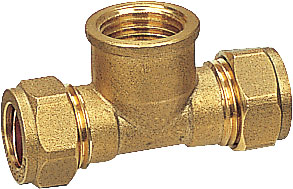
| 3101 | Female iron tee | 15mm×1/2"×15mm; 22mm×1/2"×22mm; 22mm×3/4"×22mm; 28mm×3/4"×28mm (page also lists 5mm×1/2"×15mm) |
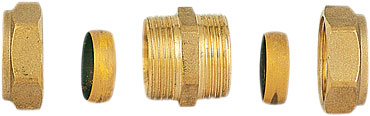
| 3102 | Straight coupler | 8mm, 10mm, 12mm, 15mm, 22mm, 28mm |
| 3103 | Stop end | 8mm, 10mm, 12mm, 15mm, 22mm, 28mm |
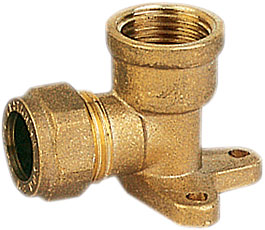
| 3104 | Female wall-plate elbow | 15mm×1/2", 22mm×3/4" |
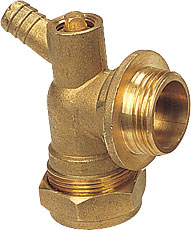
| 3105 | Elbow with drain off-cock, compression end male | 22mm×3/4", 28mm×3/4" |
Preview planning counted about five standard compression items — matching this live family. Size strings are taken from product pages; request confirmation drawings before tooling or large purchase orders.
How to select coupler vs elbow vs tee vs stop end
- Straight coupler (3102): joins two tube ends of the same OD — core restock SKU across 8–28 mm. This is usually the first line on a compression RFQ.
- Stop end (3103): caps a line for isolation or future extension — same size ladder as the coupler, often sold in smaller ratios than couplers.
- Female iron tee (3101): adds a threaded branch (1/2" or 3/4" in published combos) for valves, gauges, or take-offs. Confirm thread standard on the iron side before labeling bags.
- Wall-plate elbow (3104): exits the wall to a female thread for taps or angle valves — coordinate hole centers with sanitary trim drawings.
- Drain-off elbow (3105): compression × male with drain cock — heating drain points without separate tee plus cock assemblies.
Private-label buyers should lock nut design, olive type (brass or copper), and whether olives ship assembled or loose. Those details are commercial choices — confirm with the factory rather than assuming from photos alone. Ask whether chrome plating is available on nuts or bodies if your brand standard requires it; C.P. language is common on the factory’s valve pages and may be negotiable on fittings through OEM.
MOQ, size mix, and container planning
The live site does not publish a universal MOQ number on the compression pages reviewed. Operationally, importers usually negotiate trial cartons after free samples, then scale to mixed-size master cartons. Use the FAQ lead-time bands as planning anchors: about 15 days when quantity is not large, about one month for large quantity. Quotes are described as showing material price, with adjustment if metal moves when the order is placed — build that clause into your commercial terms so finance is not surprised.
A practical size-mix approach for first containers: overweight 15 mm and 22 mm couplers and stop ends, include a smaller layer of 8–12 mm for specialty, add 28 mm for commercial jobs, then layer wall-plate and drain-off SKUs against your heating and sanitary forecasts. Pair the fittings booking with brass ball valves so freight cost per sellable SKU drops.
Industry-typical installation notes (clearly labeled)
The General Ball Valve product pages reviewed do not publish torque charts or olive metallurgy. Ask for assembly notes with your sample order if you train installers or print instructions on bags. Do not invent torque values in your catalog PDF.
Dimensional QC before the first container
Compression leaks in the field are almost always tolerance or assembly issues. Before you scale production:
- Measure tube seat dimensions on five pieces per size against your copper sample.
- Check nut hex size consistency for tool branding and installer expectation.
- Verify olive hardness and material if you specify copper versus brass olives.
- Pressure-test assembled joints in your lab at the pressure your market expects — do not invent a factory rating that is not on the product page.
- Review bag labels for size, batch, and barcode readiness for your warehouse system.
- Confirm packing includes logos and approval marks if those are part of your private-label file — the factory FAQ lists those checks in finished QC.
Factory capabilities behind the fittings
From published About and FAQ content:
- Location: Yuhuan County, Zhejiang, marketed as the “Capital of valve.”
- Processes: hot forging, sand casting, CNC machining.
- Quality system wording: ISO 9001:2000 authorization (confirm the current certificate on audit).
- Export: about 95% to Europe, North America, and other developed countries.
- Material: common brass Cu 57–59%, Pb ≤3%, Fe ≤0.8%, Ni ≤1%; other brass or bronze available.
- OEM: new moulds to drawings; CAD via AutoCAD, Pro-E, SolidWorks; more than a decade of OEM/ODM experience claimed.
- Samples usually free; lead time about 15 days for smaller quantity and about one month for large; response within 24 hours claimed; quotes track material price.
Contact channels: telephone +86-576-8742 2259, emails [email protected] and [email protected], plus the contact page. Read the FAQ and about page before the first call so your questions map to their published process language.
Compression vs solder pipe fittings vs press (same supplier)
| Family on site | Joint style | Buyer cue |
|---|---|---|
| Compression fittings | Nut and olive | Serviceable; no flame; strong DIY and pro crossover demand |
| Pipe fittings | Solder × thread | Permanent copper joints; 15/22 mm SKUs published |
| Press fittings | Press tool | Speed on large jobs; tool ecosystem matters |
| PEX fittings | PEX connection | Radiant and plastic tube markets |
Many distributors stock compression and solder transitions together. Sourcing both from one brass manufacturer simplifies QC and carton branding. Add hose fittings or quick couplings when outdoor and utility attach rates justify another layer in the same container.
RFQ and QC checklist
- Call out SKUs 3101–3105 with millimeter size splits and monthly or annual volume.
- Specify olive material, whether pre-assembled, and nut finish.
- For 3101, 3104, and 3105, state thread standard on the iron or male side.
- Request dimensional drawings: tube seat, thread length, wall-plate hole centers.
- Ask for a material report versus FAQ brass chemistry; flag lead-free needs early.
- Define bag labels, barcodes, and multi-size master cartons.
- Order free samples; pressure-test in your lab before the first container.
- Align lead time and material-price adjustment with the published quoting method.
- If you need sizes beyond the published ladder, ask about new mould cost and ownership.
Source compression fittings from the factory
Bottom line
Brass compression fittings programs succeed when size ladders (here, notably 8–28 mm on couplers and stop ends) and hybrid thread branches are specified from real catalog pages — not generic stock photos. General Ball Valve Factory publishes a compact but clear compression family you can RFQ alongside valves and solder pipe fittings from the same Yuhuan plant. Keep datasheet claims limited to published sizes and separately documented test results.