Procurement hub · Brass valves
Brass Ball Valve Manufacturer Guide: How to Qualify a China Factory for Wholesale & OEM
If you are searching for a brass ball valve manufacturer — not a trading desk that forwards emails — this guide walks through factory qualification, catalog specs you can actually RFQ, and how Yuhuan-based forge + CNC plants like General Ball Valve Factory structure OEM and wholesale supply for Europe and North America.
Why brass ball valves still dominate plumbing procurement
For residential and light commercial water lines, threaded brass ball valves remain a default specification: machinability, corrosion resistance in potable and heating circuits, and a mature global tooling ecosystem. Buyers who type “brass ball valve manufacturer” into search are usually past DIY curiosity. They need a plant that can repeat forge geometry, hold thread gauges, plate or polish consistently, and ship container quantities with packing marks that survive customs and warehouse receiving.
Generic “ball valve manufacturers” often mean stainless flanged or API-style industrial valves. That is a different machine park. If your demand is threaded brass for plumbing, HVAC, gas distribution (where rated), hose bibs, and mini isolation valves, shortlist factories whose published catalog is brass-first — not a one-page stainless brochure with a brass afterthought.
General Ball Valve Factory positions itself exactly in that brass lane: a Chinese manufacturer of brass fittings and brass ball valves located in Yuhuan County, Zhejiang — a region marketed as “the Capital of valve.” The factory describes a coordinated process of hot forging, sand casting, and CNC machining, states authorization of ISO 9001:2000 (wording as published on site; confirm current certificate revision during audit), and notes that about 95% of products are exported to Europe, North America, and other developed markets.
How to qualify a brass ball valve manufacturer (not a reseller)
Procurement teams waste months when a “manufacturer” quote is actually a trader markup on someone else’s forge. Use these factory signals — all of which map to claims and FAQ language on the General Ball Valve site:
- Process stack named in public copy: hot forging + casting + CNC, not “we source from partners” vagueness.
- SKU-level catalog: item numbers, handle types, FxF/FxM, thread standard, size ranges.
- OEM tooling language: willingness to open new moulds to drawings; CAD tools named (AutoCAD, Pro-E, SolidWorks on their FAQ).
- In-house QC narrative: material analysis → process control → finished measure/test including packing, logos, approval marks.
- Export orientation: response within 24 hours claimed; lead-time bands for small vs large quantity.
Ask for process photos of forging dies and machining cells during video audit. Ask which SKUs are forged vs cast. Ask whether chrome plating is in-house or subcontracted. None of that invents certifications you do not have — it simply verifies the manufacturing story behind the catalog.
What a real brass ball-valve catalog looks like
On the brass ball valves category, General Ball Valve lists a dense standard range (about 30 ball-valve SKUs in the rebuilt catalog count used for planning). Adjacent valve families on the same site include gas valves, radiator valves, angle valves, mini valves, and bibcocks — useful when a wholesaler wants one brass source for multiple aisle SKUs.
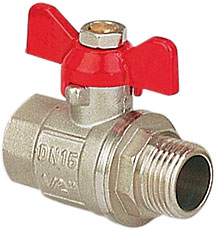
Below is a sample of published SKU introductions (verbatim attributes from product pages — not invented pressure ratings):
| SKU | Published description highlights | Size range (as stated) | Thread / config |
|---|---|---|---|
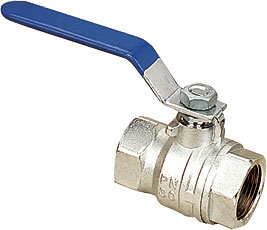
| 1101 | Forged brass ball valve; red steel butterfly handle | 1/2"~1" | FxM · ISO228 |
| 1105 | Forged brass ball valve; green steel handle | 1/2"~2" | FxM |
| 1108 | Forged brass ball valve; green butterfly handle | 1/2"~1" | FxM |
| 1118 | Forged; steel flat handle; chrome-plated; heavy duty | 1/2"~1" | FxF · ISO228 |
| 1120 | Forged brass ball valve; long stem | 1/2"~2" | FxF · ISO228 |
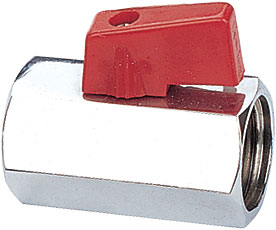
| Mini 1501 | C.P. forged mini ball valve; red handle | 1/8"~3/4" | FxF · ISO228 |
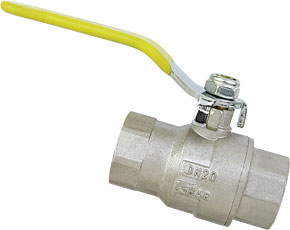
| Gas 1201 | Forged full-flow gas ball valve; yellow flat handle; working pressure 5 bar (SKU-stated) | 1/2"~2" | FxF · ISO7/1 |
Pressure: only Gas-1201 states “Working pressure: 5 bar” on the product page reviewed. Do not assume 5 bar for every ball valve SKU. Request test pressure / working pressure per item in your RFQ.
Specs that belong on your RFQ
Thread standards you will see on this catalog
- ISO 228 — parallel pipe threads appearing on multiple ball and mini valve pages (e.g. 1101, 1118, 1120, mini 1501).
- ISO 7/1 — taper pipe threads called out on gas valve example 1201.
If your market expects NPT, BSPT, or BSPP labeling on cartons and tech sheets, say so explicitly. ISO designations on Chinese catalogs often map to BSP-family threads, but receiving inspection fails when drawings and gauges are not aligned.
Connection style & handle
Catalog language includes FxF (female × female), FxM (female × male), butterfly vs flat vs lever handles, long-stem variants, and chrome-plated (C.P.) finishes. Handle color is not cosmetic only for wholesalers — it is a SKU differentiation and private-label opportunity.
Flow path
Gas SKU 1201 is labeled full flow. Other ball valves may be reduced port. If pressure drop or Cv matters for your application, ask for port type per SKU rather than assuming full bore across the line.
| RFQ field | Why it matters | Example from site language |
|---|---|---|
| Item / drawing # | Locks geometry & BOM | Ball Valves-1101, Mini-1501, Gas-1201 |
| Size range | Tooling & MOQ by size | 1/8"~3/4" (mini); 1/2"~2" (several valves) |
| Thread standard | Gauge & market fit | ISO228 / ISO7/1 as stated |
| End config | Inventory SKU count | FxF vs FxM |
| Finish | Cost & appearance | Chrome-plated / C.P. on selected SKUs |
| Handle type | Private label / aisle look | Butterfly, flat, lever, plastic |
| Working / test pressure | Safety & claims | Confirm per SKU (5 bar stated on Gas-1201 only among samples above) |
| Marking & packing | Brand compliance | Logos & approval marks checked in QC FAQ |
Material language buyers should request in writing
The factory FAQ states the main material as common brass with composition guidance: Cu 57–59%, Pb ≤3%, Fe ≤0.8%, Ni ≤1%. Other brass or bronze are said to be available. A bronze fittings family also appears in the catalog structure.
This matters for market selection. Some North American potable-water programs require low-lead or lead-free alloys with NSF/ANSI listings. The live site does not claim NSF/lead-free certification in the materials reviewed for this article. Buyers for strict potable programs should either (a) request alloy options and third-party test plans in writing, or (b) route those SKUs to a certified alloy program — without inventing claims the factory has not published.
For heating circuits, closed-loop HVAC, outdoor bibcocks, gas valves where locally approved, and many OEM assemblies, the published common-brass chemistry is the conversation starting point — get a mill/material report with the sample shipment.
OEM / ODM and private-label realities
From the published FAQ:
- Engineers design custom samples with AutoCAD, Pro-E, and SolidWorks.
- Over a decade of OEM/ODM experience is claimed.
- Techniques named: hot forging, sand casting, precision machining.
- New moulds can be made fully according to client requirement (also stated on About / homepage positioning).
Private-label buyers should budget for: mould amortization, logo die or laser/mark process, carton artwork, and first-article approval. Ask who owns the mould after tooling is paid. Ask whether packing, logos, and approval marks are part of the final QC gate — the FAQ says finished goods are measured and tested including those items.
Lead time, samples, and quoting mechanics
Published operational claims (verify on order confirmation):
- Lead time: about 15 days if quantity is not large; about 1 month for large quantity.
- Samples: usually free of charge.
- Quoting: price shown with material cost; if material price changes when the client places the order, price is adjusted accordingly.
- Response: reply as soon as possible within 24 hours claimed.
Contact channels published on site include Tel +86-576-8742 2259, Fax +86-576-8742 2649, emails [email protected] / [email protected], and location in Chumen, Yuhuan, Zhejiang (P.C. 317605).
Start an RFQ with the factory
Send item numbers (or drawings), sizes, quantity, thread standard, finish, handle preference, marking requirements, and destination port. Use the live catalog as your shared language:
RFQ checklist you can copy
- Confirm brass (not stainless) scope and list target SKUs from products.
- State thread standard (ISO228 / ISO7/1 / NPT / other) and gauge method.
- Specify FxF vs FxM, size mix, and annual volume estimate.
- Request material composition confirmation vs FAQ common brass; ask bronze option if needed.
- Ask working pressure / test pressure per SKU — do not copy 5 bar from gas SKU to all valves.
- Define finish (natural brass / chrome) and handle type/color.
- Attach logo artwork and packing mark requirements for OEM.
- Request free samples, first-article photos, and lead-time commitment for trial vs container.
- Clarify Incoterms, payment terms, and material-price adjustment clause.
- Schedule a video audit of forging + CNC + QC benches before first large PO.
Related brass product families (same factory)
Wholesalers often consolidate brass ball valves with:
- Brass compression fittings
- Brass pipe fittings
- Brass angle valves
- Brass bibcock
- Brass quick couplings
That single-source pattern reduces freight fragmentation and simplifies QC when one Yuhuan factory owns forge tooling across valves and fittings.
Bottom line
A credible brass ball valve manufacturer for plumbing/HVAC export is defined by forged catalog depth, named thread standards, transparent material chemistry, and OEM discipline — not by keyword stuffing “factory” on a trader site. General Ball Valve Factory’s about page and product SKUs give buyers a concrete starting grid. Use the checklist above, verify pressure and alloy claims per SKU, and treat the published ISO 9001:2000 wording as a conversation starter for current certificates rather than a finished compliance file.