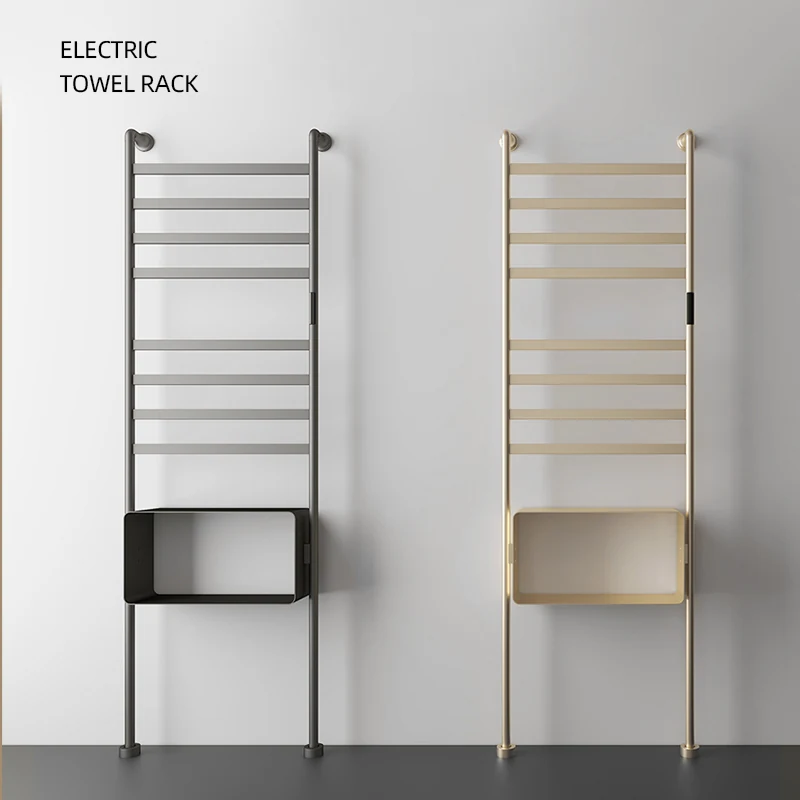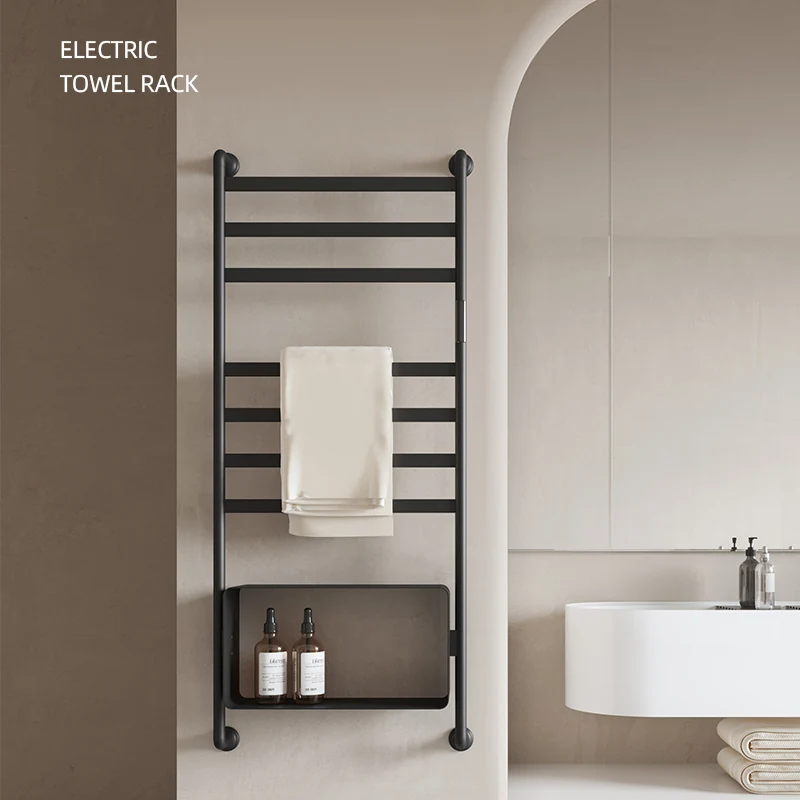
What a heated towel rail is actually doing
A heated towel rail turns its bars into sources of radiant heat. That warms the towel, but the more useful effect is that it dries the towel between uses. A towel that dries between uses does not develop the smell that sends it to the laundry early, which is why hotels look at towel rails as a laundry cost item rather than a luxury item.
Temperature and control
Our build-in modular electric rail offers step-less temperature regulation between 20 and 50 degrees C. Some individual models run at a fixed constant temperature instead — the L-SR0003, for example, is listed at 55 degrees C constant temperature with a touch screen thermostat and time control. Decide which behaviour you want before you select a model, because it is not a field-changeable setting.
The timer matters more than the wattage
The build-in modular system has a self-closing timer that switches off after two hours at full power. Over a year, a rail that shuts itself off after two hours costs a fraction of one that runs whenever the room is occupied. If a rail has no timer, the operating cost is set by guest behaviour rather than by design.
Power draw per bar
Our modular rails are rated at 10 W per bar. That makes the total easy to calculate from the bar count rather than guessing from the overall size. Individual models publish their own total: the L-SR0003 is listed at 30 W, 220 V, 50 Hz. Always design the electrical provision from the model's published figure, not from a category average.
IP rating and cable
The build-in modular rail is rated IPX4 and the build-in part is supplied with 3 metres of H05VV-F cable. Check the rating against the zone the rail sits in within your bathroom. The installation must be carried out by a qualified electrician — this is not a fitting that should be connected on site by the tiler.
Material and finish
Our rails use SUS304 tube. This matters more on a heated rail than on an unheated one, because the element drives repeated thermal cycling through the section, and a plated finish over mild steel blisters fastest exactly where it runs hottest. Finishes across the range include polished, matte black, white, gun metal and brushed brass.
Modular versus fixed
The build-in modular system is a set of bars positioned according to customer requirements, which suits a bathroom where the rail has to work around a window or a mirror. A fixed-format rail is simpler to install and is usually the right answer in a repeated apartment bathroom.