- Industry Insight: Changing Pool Light
- Technical Specifications
- Application Scenarios
- Why Choose Seven Colors Lighting
Engineering Reliability: Technical Insights into Seven Colors Lighting’s IP68-Grade LED Pool Light Solutions
In commercial and high-end residential pool installations, lighting isn’t just about aesthetics—it’s a critical component of safety, operational longevity, and user experience. Failures due to corrosion, water ingress, or thermal stress can lead to costly downtime, safety hazards, and reputational damage. At Seven Colors Lighting, our LED pool lights are engineered from the ground up to eliminate these risks. Here’s how our technical specifications deliver uncompromising performance in the most demanding aquatic environments.
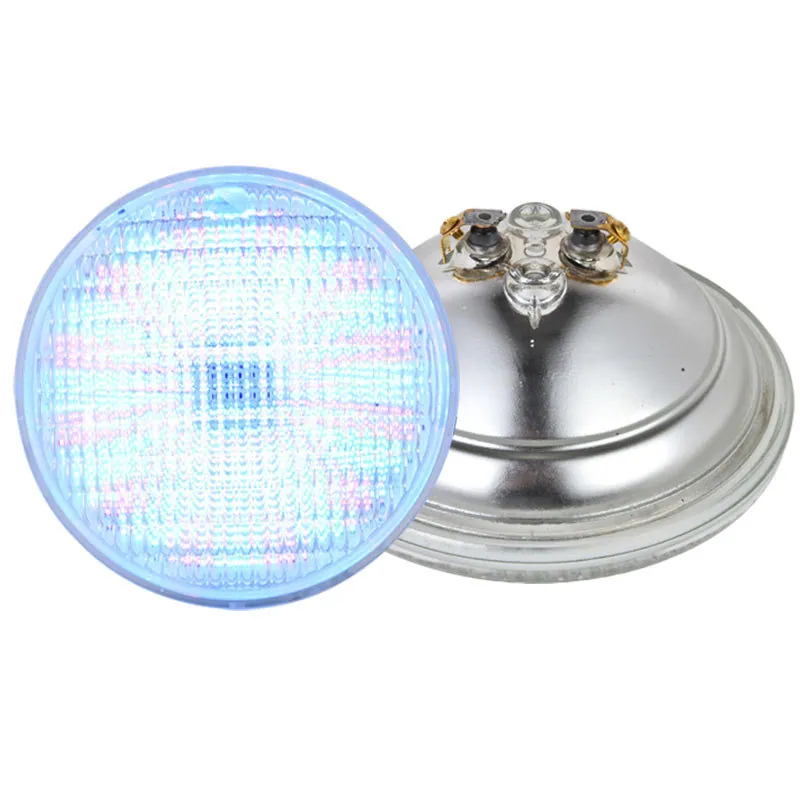
The cornerstone of our design is the IP68 waterproof rating. Unlike lower-rated alternatives that may withstand temporary submersion, IP68 certifies continuous operation at depths exceeding 3 meters under static water pressure. This means no risk of moisture penetration during routine maintenance, pool draining, or extreme weather events. Our lights undergo rigorous testing per IEC 60529 standards, including 24-hour immersion at 1.5x the rated depth while powered on. This ensures complete sealing integrity even when subjected to hydrostatic pressure fluctuations common in large commercial pools or saltwater systems.
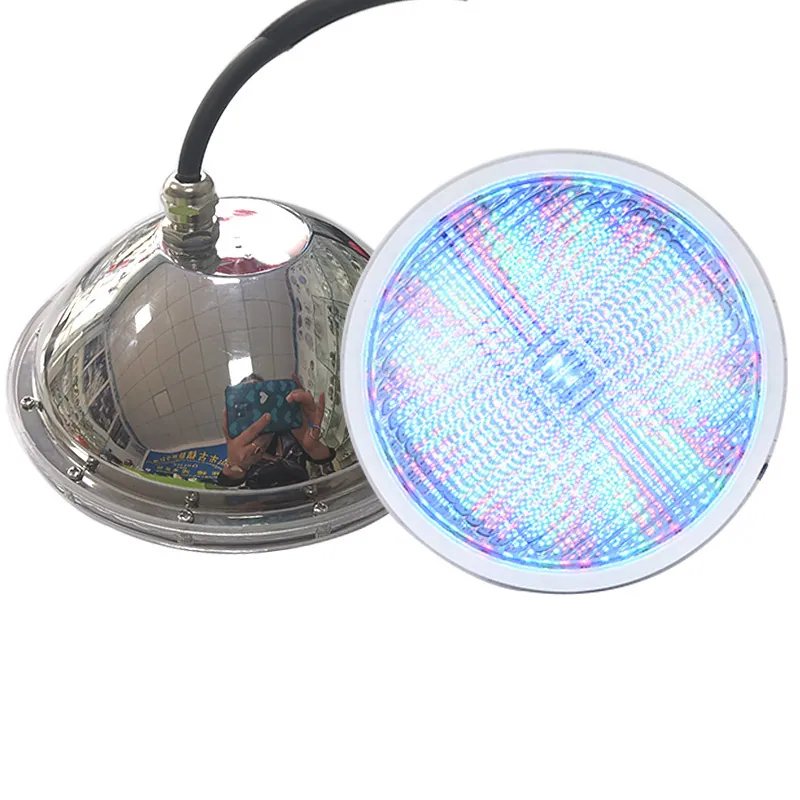
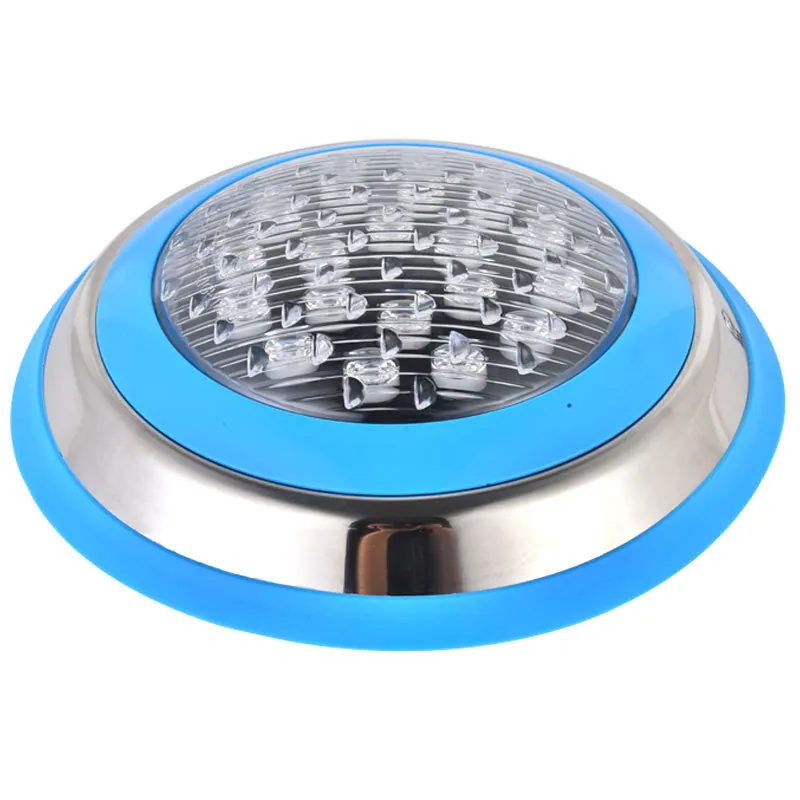
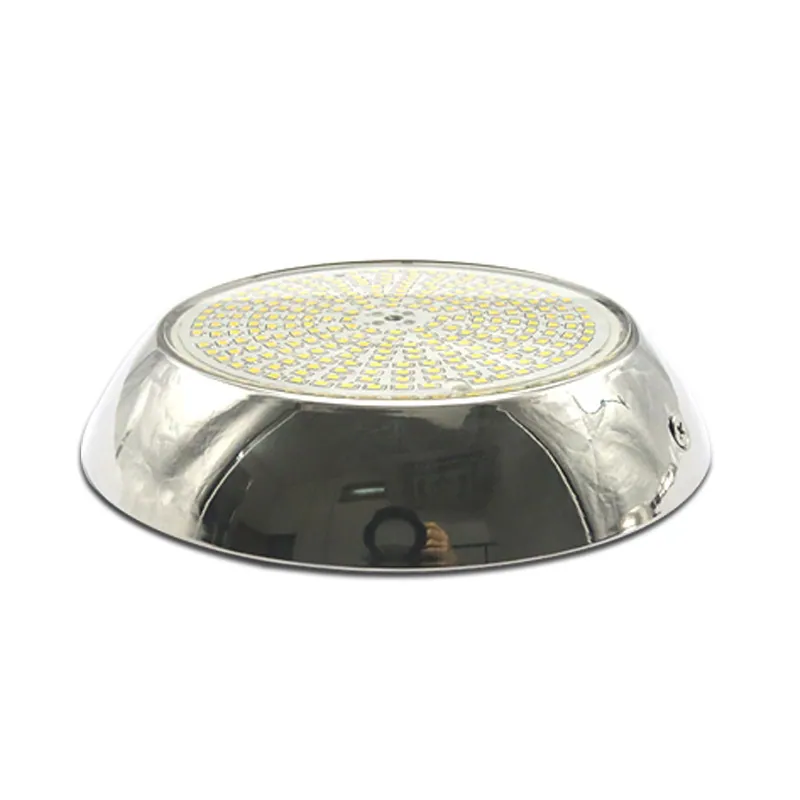
Material selection is equally critical in corrosive pool environments. We specify 316 marine-grade stainless steel for all external housings and mounting hardware. This alloy contains 2–3% molybdenum, significantly enhancing resistance to pitting and crevice corrosion compared to standard 304 stainless steel. In saltwater applications, where chloride ions accelerate degradation, 316 stainless steel maintains structural integrity for over 10 years without rust or discoloration. This isn’t merely a cosmetic choice—it’s a fundamental engineering decision that extends service life and reduces lifecycle costs.
To further eliminate failure points, our lights utilize full resin encapsulation. Unlike air-filled designs prone to condensation or thermal cycling stress, high-purity epoxy resin fills every internal cavity, bonding components into a monolithic structure. This resin acts as both a thermal conductor—dissipating heat from the LED chips—and a physical barrier against vibration, chemical exposure, and microscopic water intrusion. The result is a light that operates reliably across temperature ranges from -20°C to +60°C, with no degradation in optical performance over time.
Recognizing that project requirements vary widely, we’ve engineered flexibility into our manufacturing process. Small minimum order quantities (MOQs) as low as 50 units enable architects, contractors, and boutique pool builders to specify premium lighting without overcommitting inventory. Customization extends beyond basic color options: we offer tailored beam angles for specific pool geometries, tunable white spectra (2700K–6500K), RGBW control systems with programmable scenes, and even custom lens patterns for architectural integration. All customizations maintain the same IP68 and 316 stainless steel specifications, ensuring no compromise on core reliability.
For projects where longevity and precision matter, our LED pool lights deliver engineering-grade performance from installation to years of service. By prioritizing material science, environmental sealing, and scalable production, we eliminate the trade-offs between cost, customization, and durability that plague the industry. Contact us today to discuss technical specifications for your next project or request a sample to validate performance in your specific application.
Changing Pool Light: Where the Retrofit Opportunity Is Hiding
A Senior Engineer’s Field Guide to Application Scenarios
If you still equate “changing a pool light” with a weekend homeowner chore, you are looking at the wrong end of the market. In commercial practice, the moment a fixture fails—or the first time the energy bill lands—facility managers start Googling “how to change a pool light” in bulk. That search is your cue to bid a full LED retrofit, not a one-for-one lamp swap. Below are the places where the conversation actually starts, the compliance hurdles that decide the spec, and the upsell angles that turn a service call into a five-figure lighting package.
- Resort & Hotel Pools
- Guest-facing water is a brand asset. A single dark spot in an infinity edge at dusk is a TripAdvisor photo that lives forever.
Retrofit trigger: Existing 300 W PAR56 halogens cycling on/off due to voltage drop, or color wheels that seized two seasons ago.
Code note: NEC 680.22(C) still calls for a service switch at the panel, but most jurisdictions now accept low-voltage IP68 LED fixtures that remove the need for GFCI-protected metal niches.
Upsell: Addressable RGBW nodes tied to the same DMX universe that runs the façade. Sell the director of engineering on synchronized “sunset fade” sequences and you move the quote from maintenance CapEx to marketing OpEx.
- Class-A Office Building Rooftop Pools
- These are small (30–80 m²) but high-stakes: the amenity lease clause that justifies US$80/ft² rents.
Retroft trigger: Landlord receives an ENERGY STAR score hit because the 500 W incandescent spa lights push the building over the Site Energy Use Index.
Access issue: Cranes are booked months in advance; you get one shot. Spec a 24 VDC LED plate that retrofits into the existing 11-inch niche so the pool engineer can do the final connection without a red-tag electrician on the roof.
Bonus: Integrate with the BMS via BACnet so the lights dim when the pool cover is open after 10 p.m.—an easy LEED O+M point that looks sophisticated in the tenant handbook.
- Municipal Aquatic Centers
- 50 m competition pools, 13 ft deep, with 2-second turnover. Light levels must hit 200 lx at the lane markings (FINA 2023).
Retrofit trigger: Utility rebate that pays US$0.12/kWh saved. A 12-fixture array of 2 kW metal halides becomes 240 W LED; rebate justifies the stainless-steel wet-niche replacement.
Compliance: NSF/ANSI 50 certification on the lens; ANSI/IES RP-6-20 sports lighting uniformity. Use a narrow 15° beam for the racing lanes and a 40° flood for the warm-up pool so you stay within the 0.3 uniformity ratio without adding poles.
Service angle: Offer a 10-year lease-to-own so the Parks Department books the project as an operating expense instead of fighting for bond money.
- Cruise-Ship Hull Pools
- Saltwater, 24-hour operation, no dry dock for another 18 months.
Retrofit trigger: Existing 120 VAC PAR56 fixtures show hairline cracks; replacement globes cost more than new LED assemblies once you add freight.
Solution: 24 VDC fixture molded from naval-grade 316L stainless, triple O-ring, IK10 lens. Run power through the same penetration gland used for the fiber-optic bundles you are ripping out.
Upsell: Battery-backup nodes that keep the evacuation path lit for 90 minutes after main-power loss—SOLAS regulation, and the safety officer signs the PO the same day.
- Hospital Hydrotherapy Tanks
- Not glamorous, but every fixture must be low-voltage and certified to IEC 60601-1 for patient vicinity.
Retrofit trigger: Biomedical department tags a line-voltage halogen as “equipment near patient” and demands either GFCI or removal.
Answer: 12 VDC LED with medically rated 2xMOPP driver, IP69K for chlorine dioxide fogging.
Bonus: Tunable white 2700–6500 K so physiotherapists can shift CCT to relax or stimulate patients—sell to the chief rehab officer, not facilities.
- High-School Competition Pools Built in 1978
- Original 8-inch brass niches, 8 ft on center, spalling concrete.
Retrofit trigger: District receives state energy grant if they cut lighting load 50 %.
Tactic: Use a 6-inch LED retrofit “can” that locks into the brass sleeve with an expansion ring; no chipping of gunite, no rebar encounter.
Add-on: Phosphor-converted amber channel for “Friday-night lights” rental to local swim clubs—pays for the project in year one.
- Private Club Spas & Cold-Plunge Pools
- Members pay US$15 k initiation; they expect Instagram moments.
Retrofit trigger: Color-changing halogen wheel is noisy and spoils the “zen.”
Solution: Silent, flicker-free (<1 %) 24 VDC RGBW with custom macro: 3200 K candlelight at 6 a.m., 5600 K Nordic blue at noon, 2000 K fireplace at 8 p.m.
Revenue: Events team now rents the pool for product launches at US$5 k per night—your lighting system becomes a profit center.
- Water-Park Lazy Rivers
- 1.2 mile of vinyl-lined channel, 600 fixtures.
Retrofit trigger: Maintenance crew is replacing 75 lamps every week; union overtime is out of control.
Answer: Low-profile 12 VDC LED strip extrusion epoxied to the underside of the coping; IP68 rated to 3 m, tool-less driver cartridge swapped from the dry side.
Upsell: Fixture-integrated sensors that report water temperature and flow to the SCADA system—sell the operational data package, not just the light.
Specification Checklist (carry this into every pre-bid walk)
Voltage class: <15 VAC or <30 VDC to avoid GFCI in most jurisdictions.
Niche compatibility: 8-inch PAR56, 11-inch SP0600, or 6-inch small-can—bring a caliper.
Lens material: Borosilicate glass for chemical pools, PMMA for saltwater (less boron leaching).
Beam spread: Calculate target lux, not just lumens; water absorbs 45 % of red at 2 m.
Certifications: UL676 for wet-niche, CSA C22.2 No. 89 for Canada, CE for EMEA, ABYC H-27 for yachts.
Control protocol: DMX/RDM for color, 0–10 V for white, BACnet for BMS tie-in.
Warranty: 3 years full, 5 years prorated on LED, 10 years on niche housing. Anything less and the purchasing manager will make you match the cheap Internet kit.
Closing the Deal
Stop talking about “changing a pool light.” Instead, propose “a zero-downtime, code-compliant, IP68 LED upgrade that cuts energy 80 % and gives you color-branding you can sell.” Bring a submersible demo bucket to the walk-through; nothing convinces a CFO faster than watching 15 W produce 1 500 lm underwater while the incumbent 300 W PAR56 barely glows. Once they see the footprint shrink, the conversation moves from cost to value, and you stop being a maintenance vendor and start being the lighting partner who keeps their water bright and their balance sheet brighter.
In today’s competitive lighting market, procurement challenges such as supply chain volatility, cost pressures, and delivery delays can significantly impact project timelines and profitability. As a Senior Lighting Engineer at Seven Colors Lighting, I’ve seen firsthand how these issues affect our partners. That’s why our integrated supply chain model—built on 1000+ coordinated factories, factory-direct pricing, and rapid delivery capabilities—has become the cornerstone of our partnership strategy.
Our network of over 1000 strategically coordinated manufacturing facilities isn’t just about scale—it’s about resilience. This distributed infrastructure allows us to dynamically allocate production based on regional demand, seasonal fluctuations, and project-specific requirements. Whether you’re managing a large-scale commercial rollout or a time-sensitive municipal project, this network ensures consistent quality and the ability to scale seamlessly. Each factory operates under our stringent quality control protocols, meaning every component meets the same high standards regardless of location. This redundancy minimizes single-point failures, a critical advantage in an era of global supply chain disruptions.
By eliminating intermediaries, we pass direct savings to our partners. As the sole point of contact between manufacturers and clients, we maintain full transparency in pricing and cost structures. This isn’t just about lower numbers—it’s about predictable margins. When you source through Seven Colors Lighting, you’re accessing factory-level pricing without the markup layers typical of traditional distribution channels. Our engineering and procurement teams work directly with each facility to optimize production costs while maintaining quality, ensuring you receive competitive pricing that aligns with your project budgets.
Speed is non-negotiable in lighting projects. Our logistics network leverages the geographic distribution of our factories to minimize transit times. By strategically aligning production locations with regional demand centers, we reduce shipping distances and customs delays. Standard lead times are consistently 30-45% faster than industry averages, and our dedicated logistics team monitors each shipment in real-time. For urgent projects, we offer expedited options that leverage our coordinated factory network to prioritize production and shipping routes, ensuring your products arrive on schedule—every time.
Partnering with Seven Colors Lighting means integrating a supply chain engineered for reliability, efficiency, and cost-effectiveness. With 1000+ coordinated factories, factory-direct pricing, and rapid delivery capabilities, we remove the friction from your procurement process, allowing you to focus on innovation and growth. Let us handle the complexities of sourcing and logistics while you deliver exceptional lighting solutions to your clients.
Ready to start your project? Contact
today.
- Tel/Fax:
- Address: